



Design how your business should run – and give people and AI the same playbook
Model, govern and share your processes in one place. QPR ProcessDesigner keeps process models current, easy to update and connected to real process data — so both people and AI assistants such as Microsoft Copilot, Claude and ChatGPT can work from the same operational context.
Customer rating: 9.7/10
Trusted by leading organizations to drive operational excellence, accelerate transformation, and turn complexity into measurable business results.
Your process documentation is out of date the day it’s published
Most organizations still keep their processes as static diagrams in slides, PDFs and shared folders. Versions multiply, updates depend on modeling experts, and documented processes quickly drift away from how work actually runs.
Now AI raises the stakes. AI assistants and agents are only as useful as the business context they can access. If your processes live in files no system can read, AI is left guessing how your organization works.
Many versions, no owner
Processes are scattered across tools and teams, so people follow whatever version they find first.
Designed vs. actual
Documented processes drift away from how work really flows in ERP and other systems – and nobody notices.
Invisible to AI
Copilots and agents can’t follow rules, roles and controls they can’t see.
Design how work should flow across organization
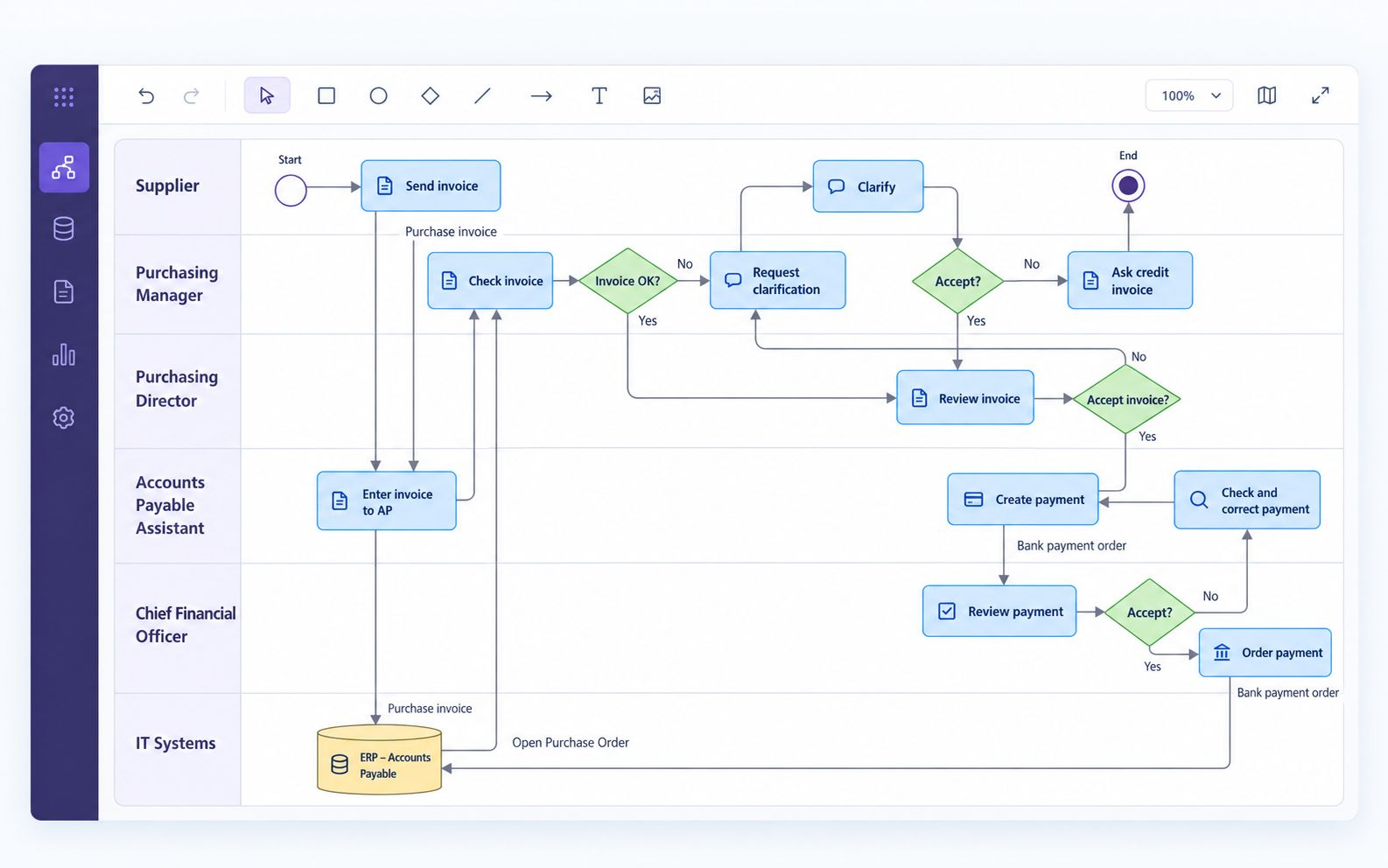
QPR ProcessDesigner is a BPMN 2.0 process modeling and management tool. It gives your organization one trusted place for processes, roles and controls – shared with everyone, and usable by AI.
- Define roles, responsibilities and decision points
- Model processes together and share them in the browser
- Give AI assistants a trusted source of how work should run
- Compare designed processes with how work really runs
- Connect processes to strategy, KPIs and execution
Your process models, available to the AI tools your people already use
AI is only as useful as the business context it understands. Through QPR's MCP server, AI assistants such as Microsoft Copilot, Claude and ChatGPT can use your approved process models – roles, rules, controls and handoffs – to answer questions and guide work.
What is MCP? Model Context Protocol is an open standard that lets AI assistants connect securely to business systems – one common plug instead of a custom integration for each.
- Answers from your own models, not generic best practice.
- One source for people and AI. Update a process, and the AI's answers change with it.
- Ready for agents. AI agents and copilots can follow your process models as instructions for how work should flow.
Run it the way your IT prefers
SaaS in the cloud
QPR ProcessDesigner is available as a service through Amazon AppStream. No servers, installations or upgrades to manage.
Single Sign-On
SAML 2.0 support lets users log in with their existing company credentials.
Cloud, hybrid or on-premise
Choose the deployment model that fits your requirements.
Certified
QPR is ISO 9001 and ISO 27001 certified.
Discover QPR ProcessDesigner in action
See how your operating model comes to life — from process design to execution.
Key capabilities of QPR ProcessDesigner
Create and edit processes together with your team in real time, and keep everything in a centralized repository. The repository is the single source of truth for process content — roles, responsibilities, controls, inputs, outputs, documents and approved ways of working — so everyone works from the same, current version.
Model in the standard BPMN 2.0 notation, with a tool palette that reflects the chosen modeling language. Move between three complementary views: Diagram view to design your plans and processes, Navigator view to manage your repository of elements and attributes, and Matrix view to visualize relationships between elements.
Keep processes that are under development separate from those that are published. Work in progress never disrupts the approved processes your organization relies on, and documentation quality stays under control.
Adapt the tool to your organization's standards and structures. A base model defines the modeling rules and controls that fit your organization, and child models inherit them; role-based governance manages process lifecycles and access rights. The open metamodel lets you fit QPR to your own governance model and quality requirements.
The modeling tool is available in 20+ languages and supports multilingual modeling and publishing. Global teams can read, maintain and align on process information in their own language, which makes standardization across regions far easier.
Publish technical BPMN diagrams as clear, business-friendly views through QPR BusinessPortal. Anyone in the organization can read, navigate and comment on processes without modeling expertise, and role-based views show each audience exactly what matters to them.
Attach documents and other supporting material directly to process elements, so the process model and its documentation live together. Models can also be exported to Microsoft tools for reporting, communication and further editing.
Visualize dependencies and relationships across processes to understand how a change in one area affects the wider business architecture. Strategic views and dependency analysis make the impact of updates visible before they are made.
Bridge the gap between designed and actual processes by connecting process design with QPR ProcessAnalyzer's process mining insights. Organizations can compare the intended way of working with how processes truly run in practice — turning the model into a living operating model connected to real data.
Use AI to accelerate modeling: Text-to-BPMN turns natural-language input into process drafts, lowering the barrier to documenting new processes. Because models are AI-ready by design, they also serve as instructions and business context for AI agents and copilots.
QPR ProcessDesigner exposes its process models to AI tools through an MCP (Model Context Protocol) interface — an open standard for connecting AI systems to external data and tools. AI clients such as Microsoft Copilot, Claude and ChatGPT can connect to QPR and query the process repository directly, so users can ask natural-language questions about how work is designed and get answers grounded in the organization's approved process models. This makes "headless" usage possible: process intelligence is available to AI agents wherever they run, not only inside QPR's own user interface.
QPR ProcessDesigner is available as SaaS through Amazon AppStream, freeing your resources from server hosting, installation, software updates and maintenance. It is cost-efficient and supports Single Sign-On (SAML 2.0).
See how leading companies drive change
Wärtsilä transformed their internal audit approach with QPR ProcessAnalyzer
"We get total visibility to our processes and data, there’s no longer a need for extrapolation and assumptions based on sampling."
Metsä Group eliminates uncertainties through continuous improvement
"The process insight and facts delivered by QPR ProcessAnalyzer were priceless. We were immediately able to focus our process improvement activities on the right things to achieve the results our business needed. Not wasting time on trial and error.”
Piraeus Bank cuts lead times by 86% through unprecedented process transparency
Piraeus Bank locates process bottlenecks and increases efficiency.
"We gave the data to QPR ProcessAnalyzer, and right away, in 5 minutes, we saw the bottlenecks of the process."
Sanofi streamlined their internal job change process with QPR ProcessAnalyzer
“By combining user-centric process design with QPR ProcessAnalyzer, we reduced the median Job Change Process duration from 8.9 to 0.9 days and cut completion times by 90%.”
Take the next step in process excellence.

How Ericsson Uses Process Mining for Trade Compliance | QPR