sanofi logo

How Sanofi Uses Process Mining to Build a Center of Excellence and Improve Procurement, HR, and Finance

Key results at a glance

  • 5+ years of enterprise process mining with QPR ProcessAnalyzer

  • 200+ employees certified in process mining in 2025

  • 4,904 fewer procurement change events within 4 months

  • AI-powered root cause analysis automated in HR operations

  • Process mining scaled across procurement, finance, supply chain, R&D, and HR

Sanofi has spent more than five years scaling process mining across its global business operations using QPR ProcessAnalyzer. What started with two pilot processes has evolved into a company-wide process mining Center of Excellence, helping teams improve procurement, finance, HR, manufacturing, and R&D processes through data-driven insights and AI-powered root cause analysis.

Company snapshot

Industry: Global biopharmaceuticals
Employees: 100,000+
Operations: 100+ countries
Core processes analyzed: Procurement, HR, Finance, Supply Chain, R&D
Technology ecosystem: SAP, Snowflake, ServiceNow, QPR ProcessAnalyzer
Headquarters: Paris, France

What you’ll learn from this customer story:

  • How Sanofi built a process mining Center of Excellence

  • How AI and LLMs support weekly root cause analysis

  • How procurement teams reduced 4,904 undesired change events

  • How Sanofi scaled process mining knowledge to 200+ employees

  • Why Sanofi chose QPR ProcessAnalyzer to scale enterprise-wide process intelligence

Why Sanofi chose QPR ProcessAnalyzer

Sanofi selected QPR ProcessAnalyzer for its ability to combine process mining, root cause analysis, AI-powered insights, and operational dashboards in one enterprise platform. Its flexibility to integrate with SAP, Snowflake, and ServiceNow enabled Sanofi to scale process intelligence across multiple global business functions.
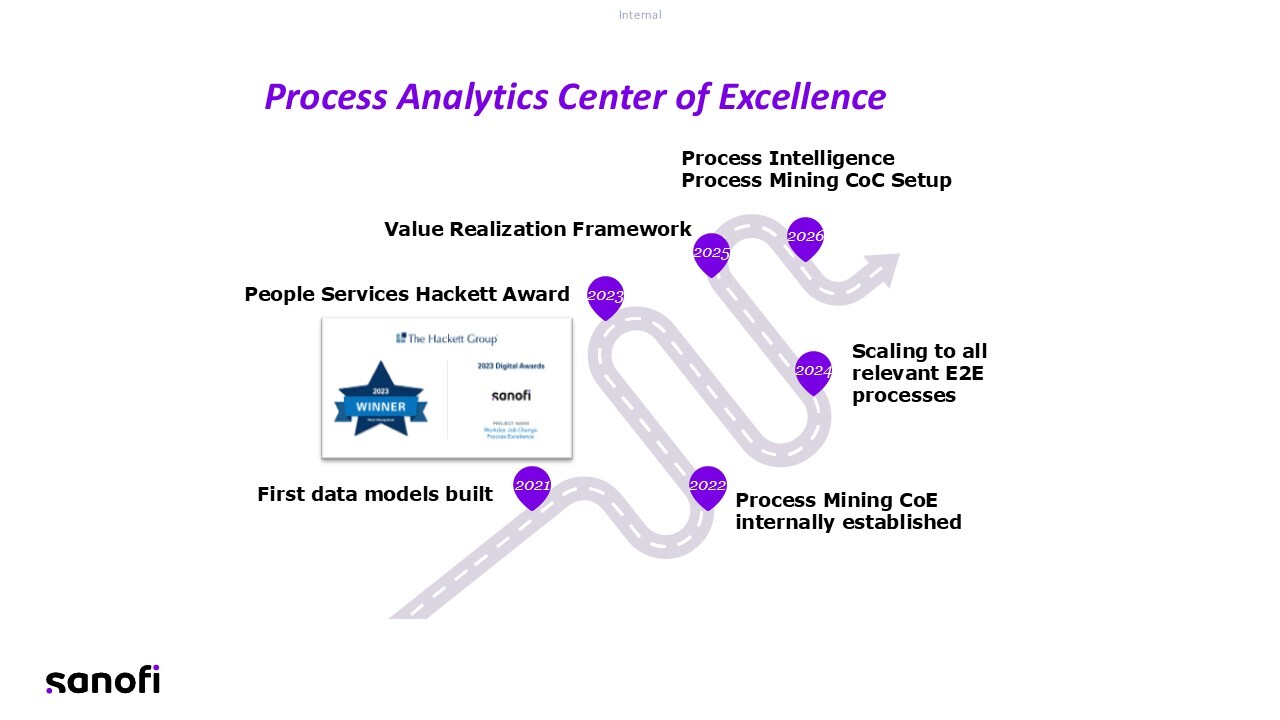
Sanofi process mining center of excellence timeline showing enterprise-wide scaling with QPR ProcessAnalyzer

Sanofi’s Process Mining Center of Excellence

Sanofi’s Process Mining Center of Excellence was established within the Business Operations organization to elevate core processes through data-driven insight. Since 2021, the team has grown from an initial focus on Procure-to-Pay and Invoice-to-Cash into a dedicated Center of Excellence for process mining — collaborating across virtually every end-to-end process in the company.

The journey: from first use case to Center of Excellence

Sanofi’s enterprise process mining journey with QPR began in 2021 and has evolved into a scalable Center of Excellence model for operational excellence and business transformation.

  • 2021 First initiatives launched to analyze Purchase-to-Pay and Customer Invoice-to-Cash processes.

  • 2022 The team received a mandate to formalize as a Center of Excellence dedicated to process mining activities.

  • 2023 Won the Hackett Group award in the Talent Management category for achieving significant cycle time reduction in job change process execution.

  • 2024 Scaled to Snowflake as the core data foundation and extended scope to manufacturing, launch, and R&D sites.

  • 2025 Redesigned ways of working with the Value Realization Framework; embedded AI capabilities; certified 200+ colleagues on process mining; began establishing Centers of Competency in key business areas.

The Challenge

Turning process mining insights into measurable business value 

For years the team collaborated with business process owners — enhancing processes, sharing dashboards, and providing analytical depth. But one gap remained: connecting all the insights to measurable, quantifiable value.

  • Long collaboration cycles without clear deadlines made it difficult to demonstrate tangible outcomes from individual initiatives.

  • Business users needed time to interpret complex process mining findings and translate them into action.

  • Scaling expertise across the organization was a constant challenge — teams in finance, R&D, manufacturing, and supply all needed to understand the basics before insights could be acted on.

  • AI potential was untapped — manual effort in tasks such as analyzing free-text ticket descriptions consumed expert time that could be redirected to action.

  • Limited end-to-end visibility across enterprise processes made it difficult to identify bottlenecks, process deviations, and compliance risks.

"We can already see the knowledge base has increased and fewer and fewer questions are raised — and this directly contributes to our success and value delivery."
Adam Honved

Manager of Process Analytics, Sanofi

The Solution

A process mining framework powered by QPR ProcessAnalyzer

To scale enterprise-wide process mining and connect insights to business outcomes, Sanofi redesigned its delivery model around a structured Value Realization Framework built on QPR ProcessAnalyzer, QPR’s process intelligence software.

Project-based delivery with clear timelines

Each initiative now follows a strict two-to-three month timeline to deliver a data model and dashboards that directly answer the business's user stories. Value is framed upfront — based on existing KPI targets, pain points, or high-level numbers — and then realized during implementation, using QPR data to track the actual impact of actions taken.

Scaling knowledge through certified training

One of the most significant scaling steps came through a collaborative effort with QPR to build a tailor-made, externally recognized certification program — delivered on a dedicated platform with single sign-on. After investing just three to four hours, colleagues receive a certification in process mining that is recognized beyond Sanofi's walls. More than 200 colleagues completed the certification in the first months after its launch in 2025, directly reducing the volume of basic questions the team handles and increasing the quality of business-led analysis.

Sanofi’s Process Mining Center of Excellence model

  1. Identify business pain points

  2. Align process mining initiatives with business KPIs

  3. Build process data models

  4. Analyze bottlenecks and root causes

  5. Implement improvements

  6. Measure business value

  7. Scale knowledge across teams

"We always align with the goals of the global business process owners. If they have a target KPI, our process mining initiative should be aligned with that — this is how we frame value and prioritize the most significant business cases."
Edina Varga

Process and Data Analyst, Sanofi

Four use cases: value in practice

1. Procurement Process Mining in SAP: Reducing Undesired Change Events

Sanofi used QPR ProcessAnalyzer to perform procurement process mining across SAP, Athena, and SHIFT purchasing workflows, analyzing how material planners create, manage, and optimize purchase requisitions and purchase orders to identify the root causes of undesired change events.

The analysis revealed recurring patterns, bottlenecks, and root causes behind these undesired process changes. Alongside the analysis, the team built a Value Realization Dashboard enabling stakeholders to track trends over time — selecting a "before" and "after" period anchored to the go-live date of the solution (1 September 2024). Monthly follow-ups were held with the business, and after four months a consistent downward trend in change occurrences became clear. The result: 4,904 fewer change events in the after period compared to the before period — direct evidence that insights translated into improved process performance.
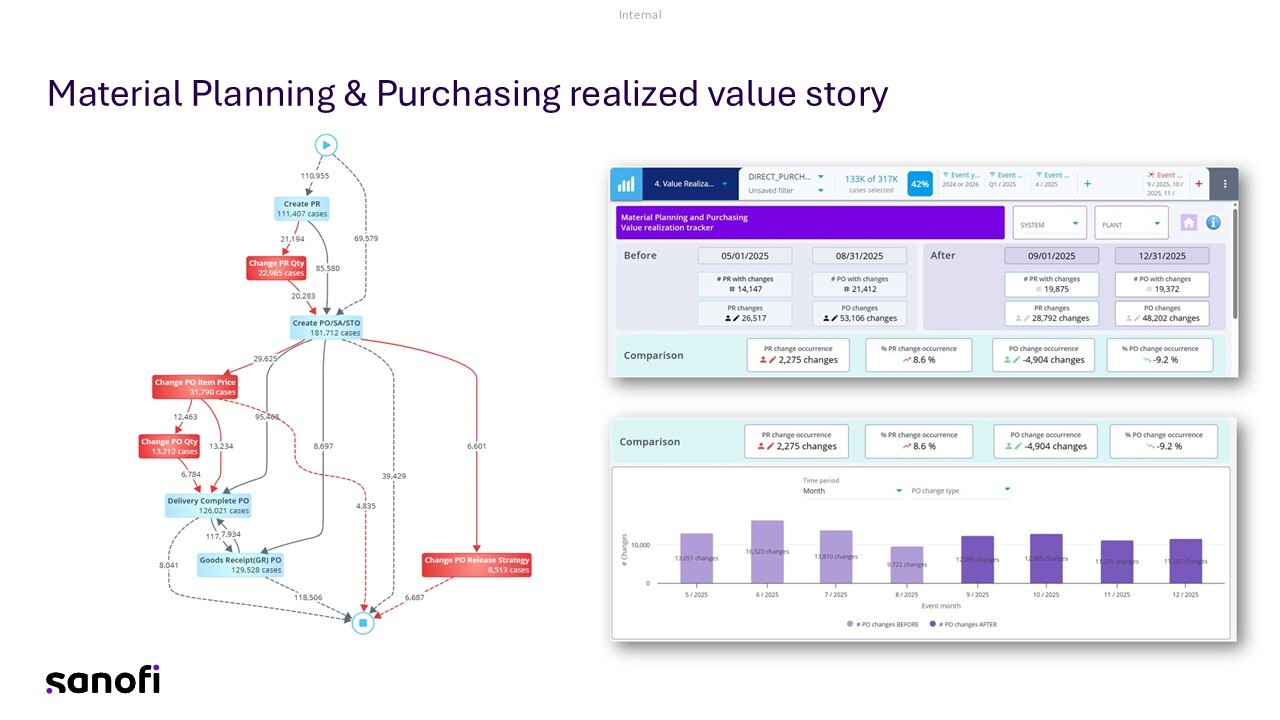
Sanofi procurement process mining results in SAP showing reduced undesired change events

2. HR Process Mining and AI Ticket Analysis in ServiceNow

HR experts were spending significant time manually reading through free-text ticket descriptions in ServiceNow to identify patterns in employee issues with payroll, vacation calculations, and time tracking. The team embedded an LLM model directly into QPR ProcessAnalyzer to automate this analysis on a weekly basis.

Now, without any manual effort, experts receive a weekly report surfacing the top reasons behind ticket volumes and trends — freeing them to focus entirely on taking action. In one example, the Budapest team's May report revealed that over half of all tickets were related to leave time tracking and payroll discrepancies — insight the team could act on immediately.
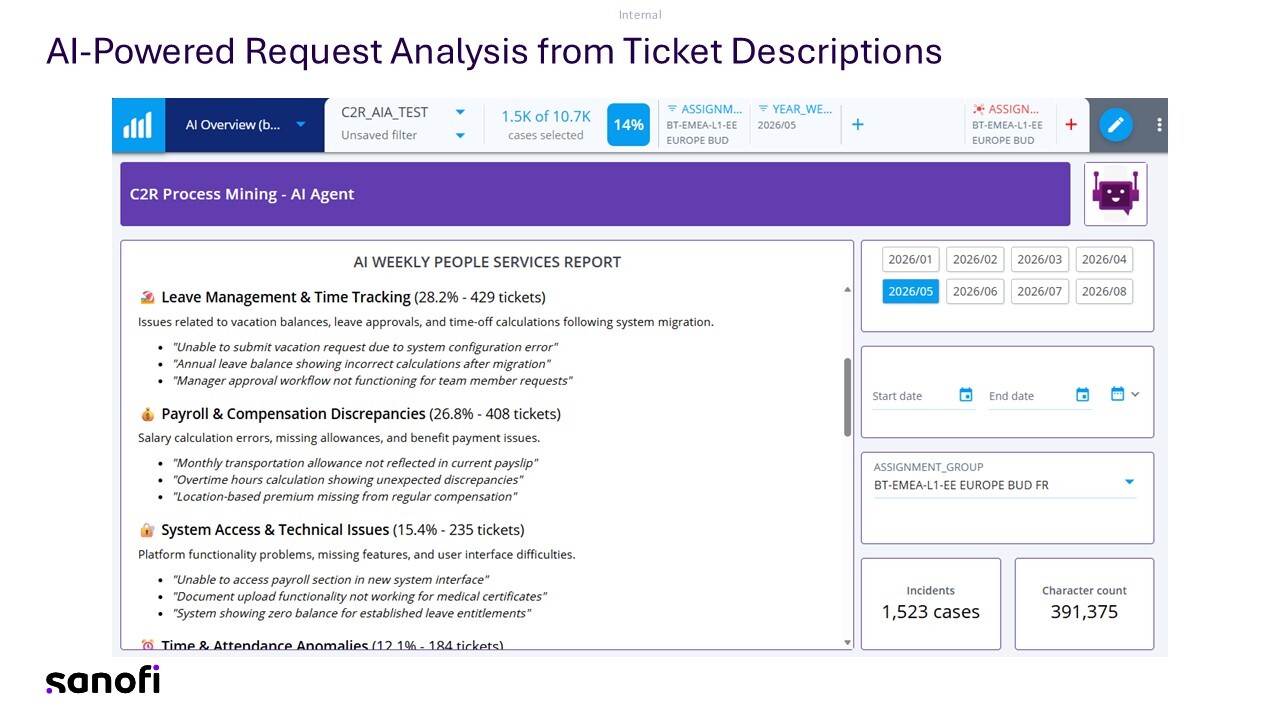
Sanofi automates HR ticket analysis with AI and process mining to identify root causes faster and improve employee experience.

This allowed Sanofi to automate HR service management analysis and improve employee experience through faster issue resolution.

3. AI-Powered Root Cause Analysis for Invoice Processing

QPR's root cause analysis functionality is powerful, but the team found that business users needed time to fully interpret findings. To accelerate this, they combined QPR's root cause analysis model with an LLM that automatically interprets and summarizes the findings in plain language.
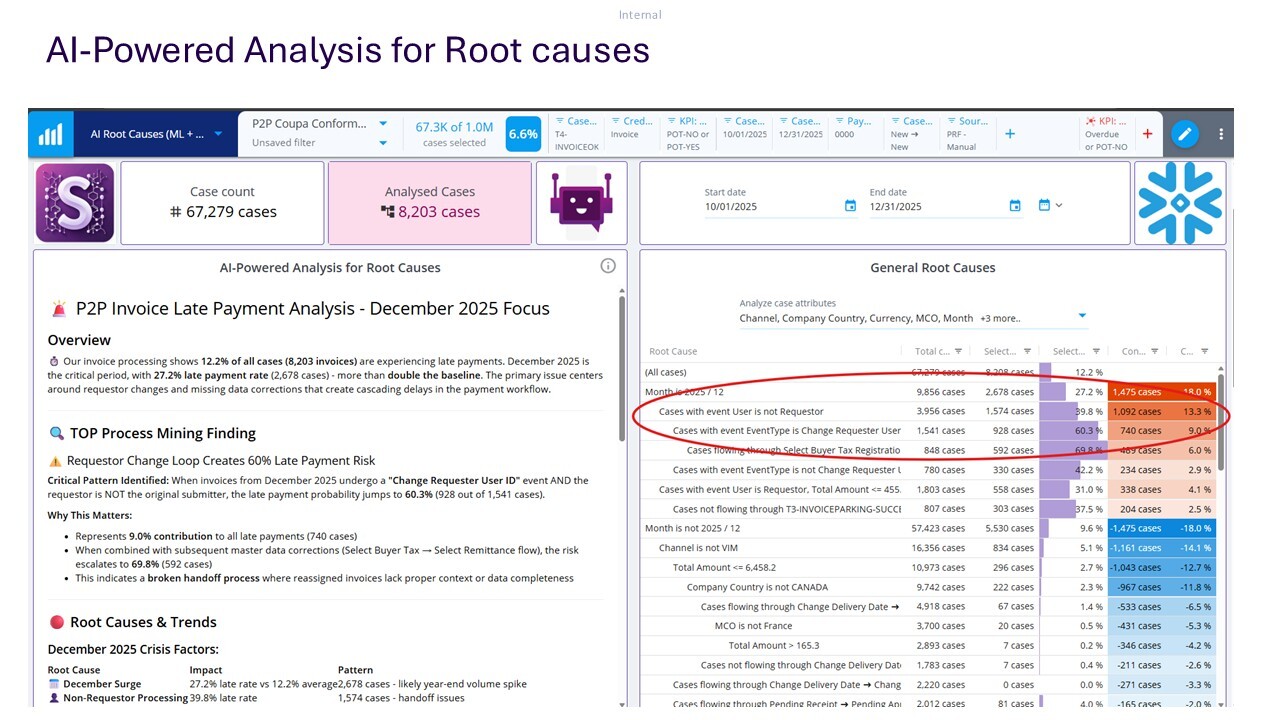
Sanofi combines QPR ProcessAnalyzer, Snowflake and AI to identify root causes behind late payments and improve invoice processing efficiency.

In one invoice processing analysis, the LLM identified that the presence of a user change request event increased the probability of late payment to 60% — communicated directly to users in a text-based summary alongside the underlying data. Accurate, data-driven findings delivered in a way everyone can act on.

This helped Sanofi improve invoice processing efficiency, reduce late payments, and strengthen financial process compliance.

4. Process Mining for Patient Onboarding and Value Measurement

For patient onboarding processes, the team built an operational dashboard in QPR where colleagues can flag individual cases for review — directly from the dashboard, with a simple right-click. Each flag creates an artificial event type ("QPR Review Action") written back to the Snowflake data model.

This makes it trivial to measure what happened to flagged cases before and after the review — and to quantify the business value generated. The number of impacted cases can be counted, the outcomes tracked, and the value of the analysis converted into a concrete business case.

This use case demonstrates how process mining can improve patient journey visibility and quantify operational improvements in healthcare processes.

Business results achieved with process mining

The combination of structured methodology, broad knowledge scaling, and AI-enhanced analytics has produced measurable outcomes across multiple dimensions.

Area

Outcome

Process improvement

4,904 fewer undesired change events in procurement within 4 months of go-live.

Knowledge scaling

200+ colleagues certified on process mining in 2025 via a QPR-built training program with external recognition.

AI efficiency

Weekly automated root cause analysis replaces manual ticket review in HR — freeing expert time for action.

Actionable insight

LLM-generated plain-language summaries cut time-to-understanding for root cause analysis outputs.

Value quantification

Operational case flagging enables direct, data-driven measurement of business impact from process mining initiatives.

Organizational reach

Process mining now spans finance, R&D, manufacturing, supply, and HR — with Centers of Competency being established in each area.

Technology impact

Enterprise-wide process intelligence built on SAP, Snowflake, ServiceNow, and AI-driven analytics.

"For me personally, contributing to the efficiency of delivering products like our immunology vaccine — knowing it protects more than 6 million infants each year — makes this work genuinely motivating."
Adam Honved

Manager of Process Analytics, Sanofi

QPR Summit 2026

Watch the full customer story from QPR Summit

Want to hear the full story directly from Sanofi’s process analytics experts?

Watch the full QPR Summit session where Adam Honved and Edina Varga share how Sanofi built its Process Mining Center of Excellence, scaled process mining across global operations, and embedded AI into root cause analysis and business value realization.

Personal demo

Ready to transform complex healthcare and pharmaceutical processes?

See how QPR ProcessAnalyzer helps life sciences organizations improve operational efficiency, reduce bottlenecks, strengthen compliance, and turn process data into measurable business value across procurement, HR, finance, and patient-facing operations.

FAQ

What is process mining and how does Sanofi use it?

Sanofi uses process mining to analyze business processes across procurement, HR, finance, supply chain, and manufacturing.

What business value did Sanofi achieve with QPR ProcessAnalyzer?

Sanofi reduced 4,904 procurement change events, automated HR root cause analysis, and trained more than 200 employees in process mining.

How does Sanofi use AI in process mining?

Sanofi uses LLM-powered analysis to automate root cause analysis, interpret free-text tickets, and improve decision-making.

Why did Sanofi build a Process Mining Center of Excellence?

To scale process mining capabilities, align with business KPIs, and turn operational insights into measurable business value.

Why is process mining important in pharmaceutical operations?

Process mining helps pharmaceutical companies improve operational efficiency, reduce bottlenecks, strengthen compliance, and accelerate critical business and patient-related processes.