
Identify the right processes to automate — and prove their impact with data
Use process mining to discover automation opportunities, prioritize high-impact use cases, and maximize ROI — directly in your data platform.
Why most automation initiatives fail
Most automation initiatives fail to deliver expected results — not because of technology, but because organizations automate the wrong processes.
Without a clear understanding of how processes actually run, automation efforts are often based on assumptions instead of real data.
Organizations struggle with:
-
Lack of visibility into real process execution
-
Automating inefficient or broken processes
-
Inability to prioritize high-impact opportunities
-
Difficulty measuring automation ROI
Process mining solves these challenges by providing a data-driven foundation for automation decisions.

How to use process mining for automation:
Identify automation opportunities in real processes
→ Find manual, repetitive, and error-prone tasks from actual data
Quantify automation impact before implementation
→ Estimate ROI, time savings, and risk reduction
Prioritize the highest-value automation use cases
→ Focus on what delivers the biggest business impact
Monitor and optimize automation continuously
→ Track performance and improve over time
Get full visibility into how your processes actually run
Process mining gives you a data-driven view of how your processes actually run — not how they are designed.
By analyzing event log data from your systems, you can identify manual work, bottlenecks, and inefficiencies that are ideal candidates for automation.
This allows you to focus automation efforts where they deliver the highest impact — reducing costs, improving efficiency, and minimizing risk.
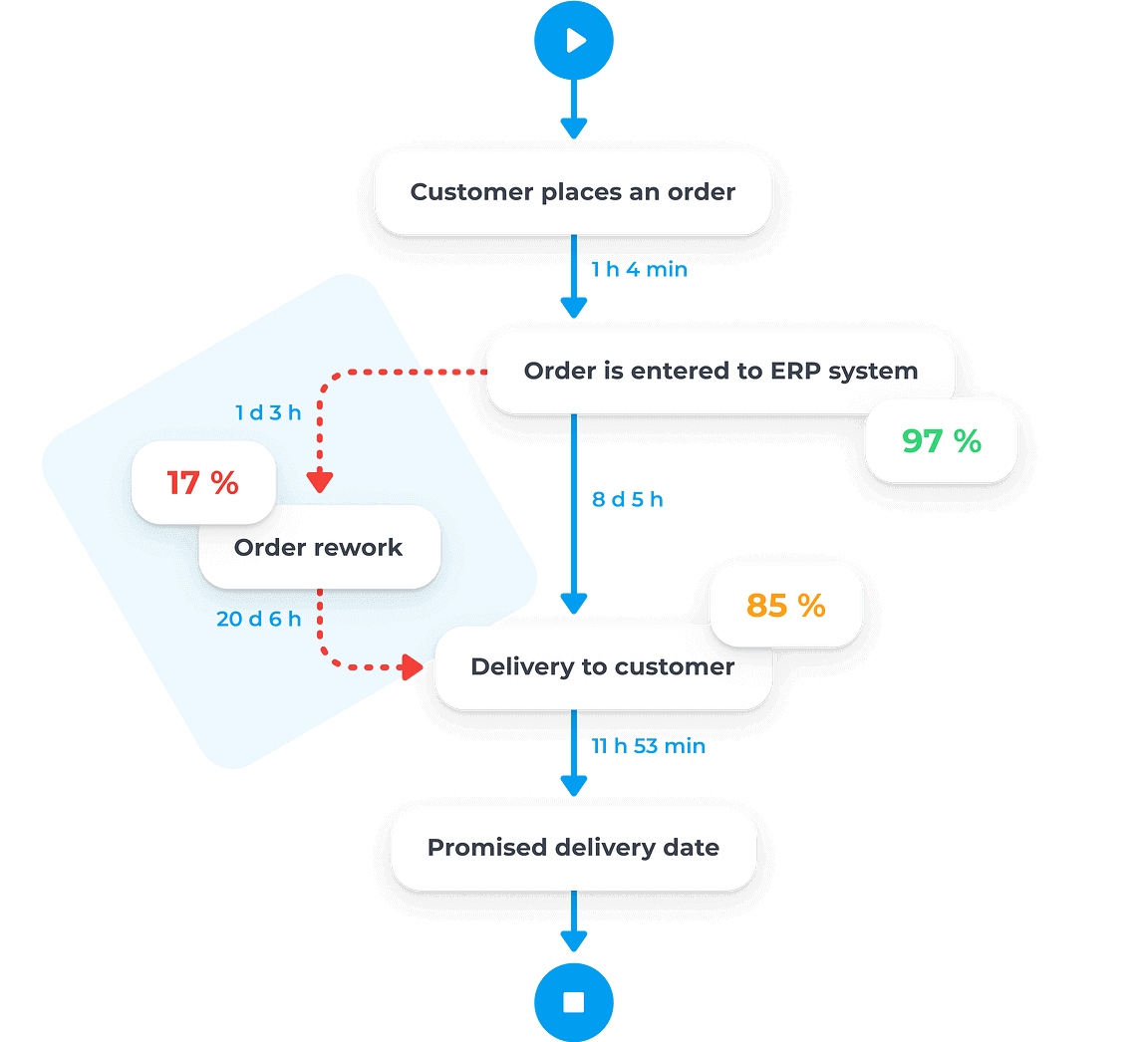
Identify the best processes for automation
Process mining reveals where work is manual, repetitive, or error-prone — based on real process data.
Identify tasks that consume time, create bottlenecks, or require rework, and prioritize them for automation.
Focus your automation efforts where they deliver the highest impact on efficiency, cost, and quality.
🔹Detect manual and repetitive tasks automatically🔹Identify bottlenecks and rework loops
🔹Prioritize high-impact automation opportunities
Measure and optimize automation performance
Track how your processes perform before and after automation — using real execution data.
Measure the actual impact of automation on cycle times, costs, and process quality.
Continuously optimize automation by identifying deviations, inefficiencies, and new opportunities.
Why Automation Fails to Scale—and How Object-Centric Process Mining Fixes It
Most automation initiatives fail to scale — not because of technology, but because they are built on assumptions instead of real process data.
Object-centric process mining provides a deeper, more accurate view of how processes actually run, helping you identify the right automation opportunities, eliminate inefficiencies, and scale automation with confidence.
.
Prioritize the right automation opportunities — based on real impact
Identify and compare automation opportunities across your processes.
Focus on the initiatives that deliver the greatest impact on efficiency, cost, and process performance.
Estimate the expected benefits of automation before you invest. Understand how automation affects cycle times, resource usage, and overall process performance.
Measure how advanced your automation is across processes and business units.
Identify gaps, track progress, and continuously improve your automation strategy.
Turn automation into measurable business impact
Automation alone doesn’t guarantee results. Process mining ensures you achieve, measure, and continuously improve the value of your automation initiatives.
Understand which processes are suitable for automation and where complexity may limit results. Focus on processes that deliver the best balance between effort and impact.
Link bots, workflows, and automation initiatives to actual process data.
Ensure automation is aligned with how processes truly run — not how they are assumed to work.
Track how automation impacts cycle times, costs, and process quality.
Identify new opportunities and continuously optimize performance over time.
How QPR ProcessAnalyzer helps you succeed in automation
It helps you identify the right opportunities, measure impact, and continuously improve your processes — all based on real execution data.
Get a transparent, data-driven view of your processes across systems.
Understand real process flows, variations, and deviations — not just designed workflows.
Automatically detect bottlenecks, manual work, and rework.
Focus your automation efforts where they deliver the greatest business value.
Use advanced analytics and AI to predict outcomes, identify risks, and optimize automation strategies.
Make smarter decisions based on data — not assumptions.
Analyze processes where your data already resides — without complex data movement.
Enable scalable, secure, and real-time process insights across your organization.
Trusted by leading global companies
"We get total visibility to our processes and data, there’s no longer a need for extrapolation and assumptions based on sampling."

Aurora Sunna, Advanced Audit Automation Analyst
Wärtsilä
“Thanks to QPR, we were able to demonstrate process bottlenecks to the broader management, identify optimization points and make recommendations to improve the consumer loan process.”

Lambros Bessas, Senior Manager
Piraeus Bank
“ProcessAnalyzer essentially helped us to create a better workplace for our employees because we removed uncertainties from our business processes, and thereby from everyone’s work day. Better processes mean more peace of mind at work.”

Matti Ketonen, VP of Supply Chain
MetsäBoard
"Process mining is going to tell you exactly where the problem is. This gives management, process owners, and business analysts a lot of information that they never had in the past. Now, the information is right at their fingertips."

Nikolay Goldovich, Head of Data, Process and Automation
Sanofi