
Fiduciary Trust International logo

How Fiduciary Trust Uses Process Mining and AI to Build Process Intelligence in Wealth Management

At a glance

Industry: Wealth Management, Financial Services, Multi-Generational Family Office

Processes: Cash Transactions, Account Opening, Account Maintenance, Client Request Workflows

Scope: Enterprise process intelligence — from process mining foundation to AI-powered interrogation, judgment support, and institutional knowledge capture

Key Outcomes:

  • Half a million process cases analyzed since January 2025

  • Hidden rework loops discovered affecting over 25% of maintenance cases

  • Complete AI-generated training guide produced from real event log data — in 15 minutes

  • MCP-powered dashboards built in approximately 10 minutes per report

  • Implicit operational knowledge converted into permanently queryable institutional memory

  • Improved operational visibility across critical wealth management workflows

About Fiduciary Trust Company

As a leading wealth management firm, operational excellence is central to delivering high-quality client service across generations.

Founded nearly a century ago, Fiduciary Trust Company was established by families, for families — with a singular focus on growing and protecting wealth across generations. The firm works with individuals, families, and foundations to build personalized investment portfolios and estate plans. Fiduciary's clients carry complex, multi-generational financial needs, and the operational infrastructure that supports them must be reliable, precise, and fast.

About-Fiduciary-Trust-Company

The Challenge

Complexity, Speed, and Hidden Operational Knowledge 

Like many wealth management firms, Fiduciary Trust faced a fundamental gap between how its processes were designed and how they actually worked. While facing increasing pressure to deliver faster client service without increasing risk, three specific challenges had been accumulating beneath the surface:

Process complexity that was invisible by design. On paper, a transaction workflow looks straightforward. In practice, hidden steps, delay patterns, and rework loops exist in every real process — but they are invisible to documentation.

Speed that amplifies risk. Fiduciary had been investing in automation and straight-through processing. But speed creates blind spots where even a small mistake can cascade into thousands of error cases. The firm needed a way to predict and prevent the hidden costs of moving faster.

Operational knowledge trapped inside people. Much of Fiduciary's deepest process expertise existed only in the minds of long-tenured employees. Whenever someone needed to understand a legacy workflow, the default was to schedule a meeting with an expert. That knowledge could not be queried or scaled, representing a significant organizational risk.

"If we were able to identify such elements of a process, we would not have designed the process that way."
Leszek Kaldus

Head of Data Strategy & Managing Director, Fiduciary Trust International

The Approach

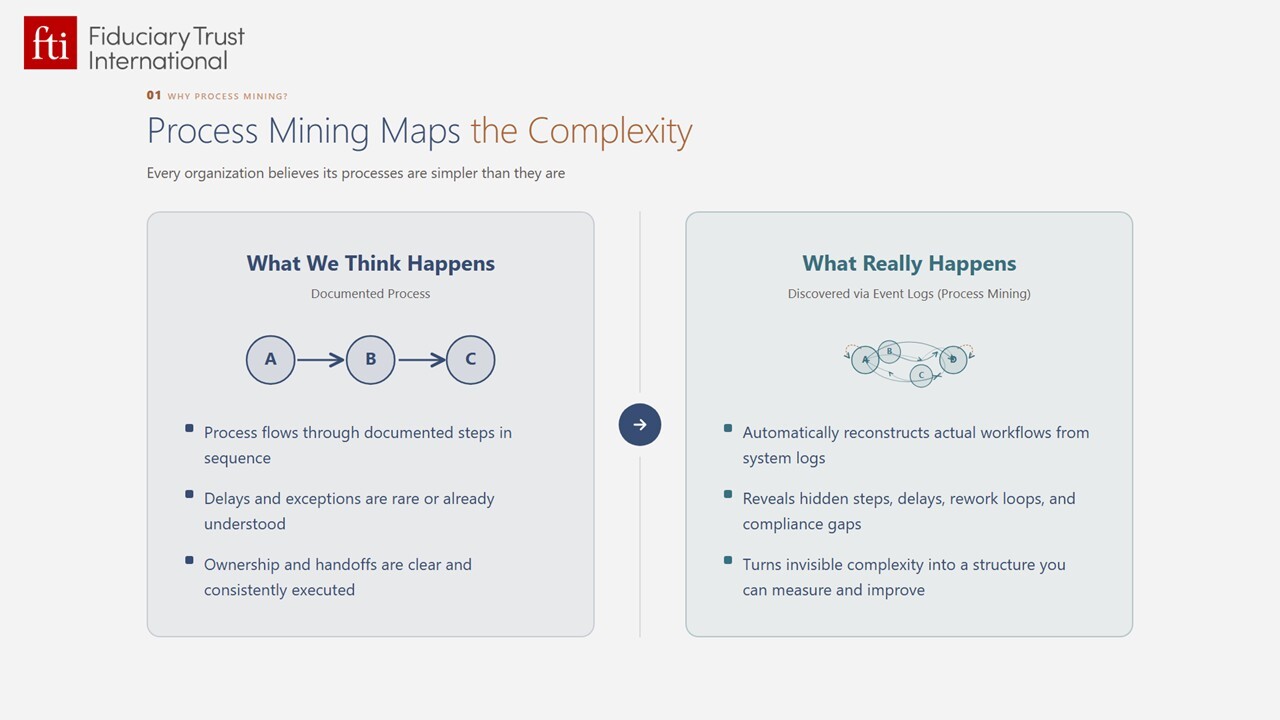
Process-mining-maps-the-complexity

The 4 Layers of Process Intelligence Framework

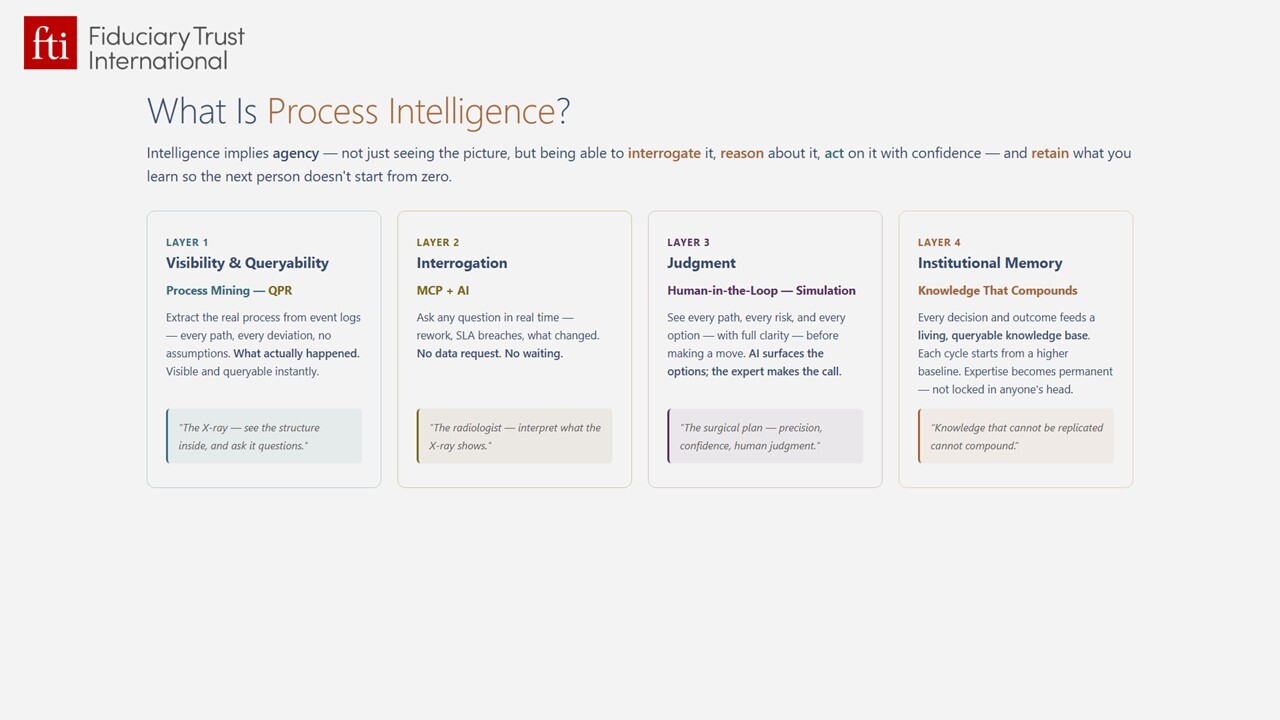
When Fiduciary Trust began its process intelligence journey in January 2025, the team did not think of it as a reporting project. They defined a framework — four interconnected layers — that would take them from basic visibility all the way to compounding institutional knowledge.
QPR ProcessAnalyzer acts-as the-X-ray-of-the-organization

Layer 1 — Visibility — Process Mining

QPR ProcessAnalyzer acts as the X-ray of the organization, reconstructing actual workflows directly from system event logs and revealing how processes truly behave rather than how they were designed.

“Process mining is like an X-ray — we can see the structure as it is actually implemented and ask any question.”
Leszek Kaldus

Head of Data Strategy & Managing Director, Fiduciary Trust International

Layer 2 — Interrogation — QPR MCP + AI

The second layer connects QPR ProcessAnalyzer to AI through QPR MCP (Model Context Protocol). QPR MCP acts as an intelligent access layer between process data and AI, enabling business users to ask questions in plain language and receive answers grounded in actual operational data — in near real time.

Layer 3 — Judgment — Human-in-the-Loop

AI presents options and simulations, but human decision-makers evaluate trade-offs and make the final call. At Fiduciary Trust, AI is a copilot — not an autonomous agent.

Layer 4 — Institutional Memory — Continuous Organizational Learning

Each process analyzed in QPR contributes to a growing body of organizational knowledge. As more processes are added, the platform becomes increasingly valuable, enabling richer analysis and stronger AI-assisted decision-making over time.

The Journey

Fiduciary Trust began its process mining journey with QPR ProcessAnalyzer in January 2025, focusing first on high-volume operational workflows to maximize insight generation.

The learning curve was real — but so was the support. The QPR team provided weekly sessions covering system navigation, data interpretation, and functionality, remaining a consistent presence throughout the onboarding period.

By the end of Q1 2025, Fiduciary had loaded its first major process: cash transactions. That single dataset already contained close to half a million cases — a volume that immediately generated meaningful patterns and analytical depth. Starting large proved to be a strategic advantage. A small process produces few patterns. A large one reveals the full complexity and variability of real-world operations.

In Q2, two additional processes were brought into the platform: account opening and account maintenance. With three processes now running in QPR, the team was able to compare workflows side by side, identify divergence between them, and begin interrogating the data through QPR MCP and AI.

What Process Mining Revealed in Wealth Management Operations

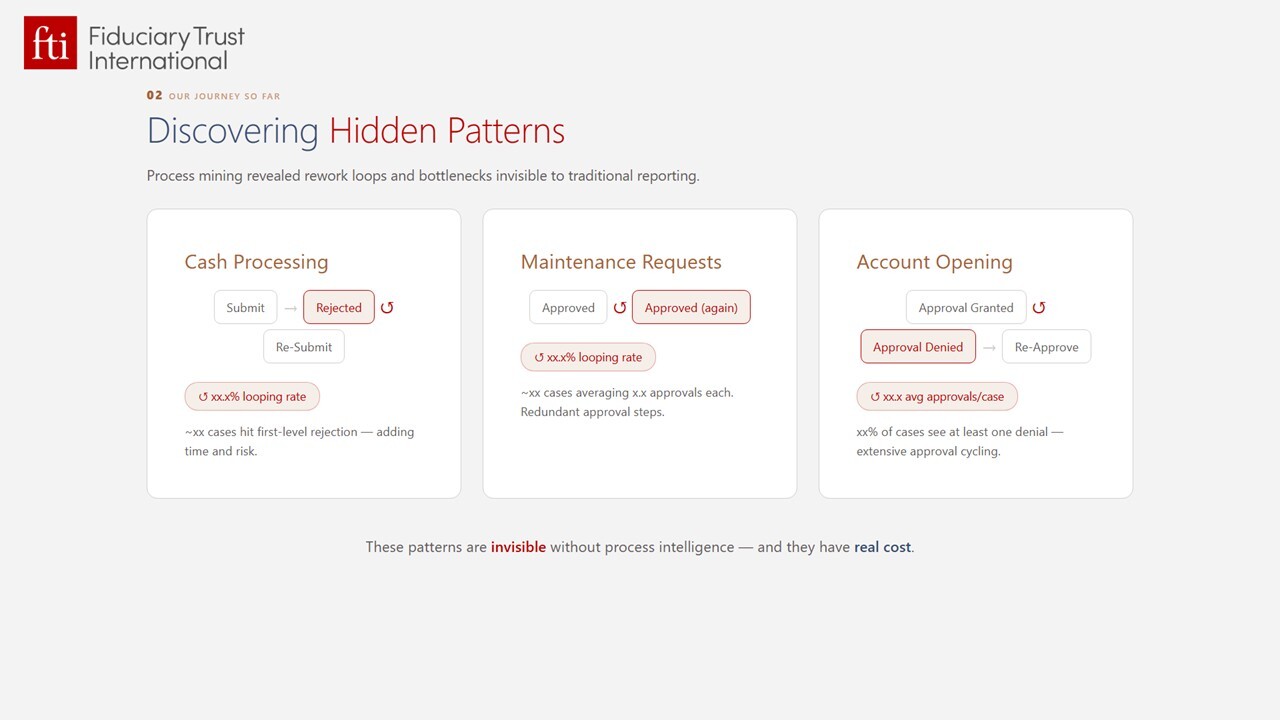
With three processes in QPR, patterns that had previously been invisible became immediately apparent.
A-dashboard-comparing- all-three-processes

Rejection and resubmission rates. A dashboard comparing all three processes showed, at a glance, which workflows carried the highest rejection rates and where cases were being resubmitted. In the account maintenance process, a significant share of cases — over a quarter — were caught in a self-loop between rejection and resubmission. That single insight prompted a direct line of inquiry: what information was missing? What documentation gaps were causing rework? And how quickly could the process be redesigned to address them?

Bottlenecks in cash processing. In the cash transaction workflow, completion rates on same-day items were high — expected, given the volume of wires and ACH transactions. But beneath that headline figure, approval bottlenecks were visible. The data showed where cases were waiting, and who or what was holding them. The team could immediately ask: is this a staffing issue? An automation opportunity? A policy threshold that should be adjusted?

Highest-impact outliers. A priority ranking showed which transaction types were carrying the greatest total lead time — surfacing exactly where optimization effort would generate the most return.

None of these patterns had been visible through standard reporting. They existed in the event log, waiting to be reconstructed.

How AI Generated Training Documentation from Process Data

The most striking example of process intelligence in action at Fiduciary Trust came from an unexpected direction: training documentation.
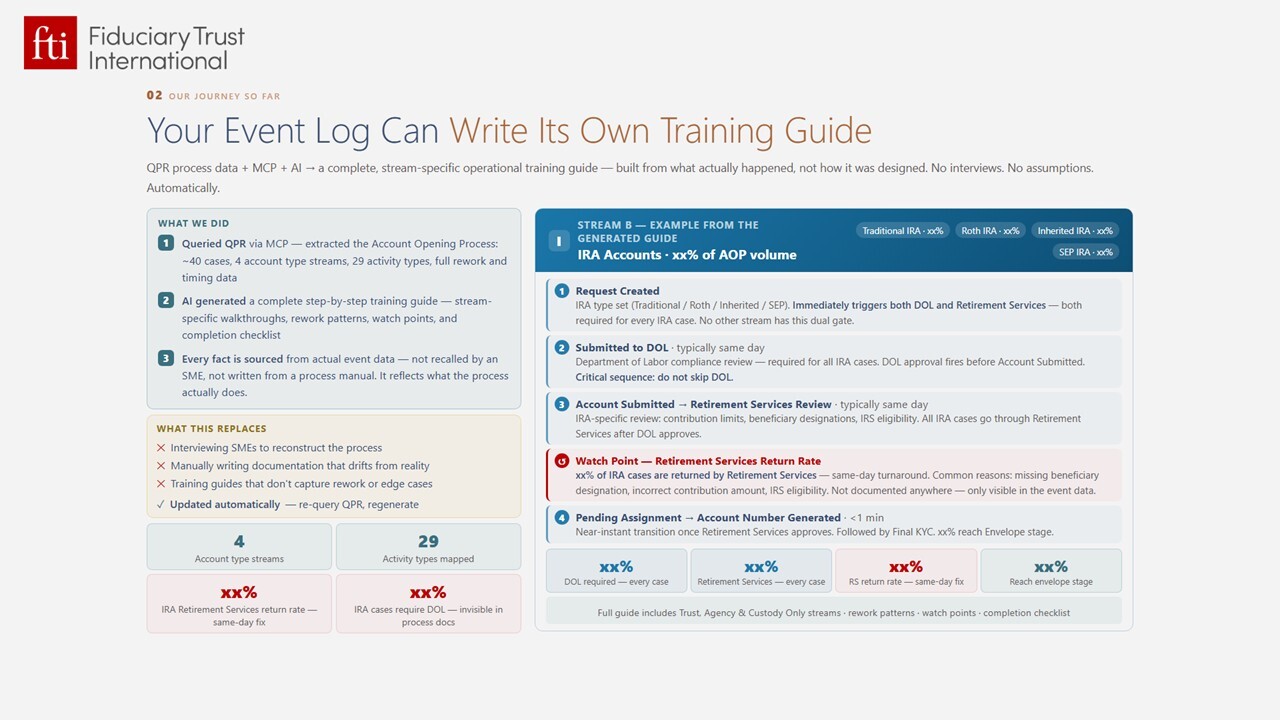
Event-log-writing-its-own-training-documentation

Using MCP and AI, the team queried QPR for the complete account opening process. They then asked the AI to generate a step-by-step training guide — not based on designed workflows or policy documents, but based entirely on actual process behavior extracted from the event log.

The result was a 14-step interactive training guide, complete with watchpoints highlighting where most errors and delays occur in practice. The guide included edge cases that no manually authored documentation would have captured, because the data revealed them directly from how the process actually runs. A short quiz followed at the end. Total production time: approximately 15 minutes.

What this replaced was significant. Traditional training documentation requires hours of interviews with subject matter experts, manual writing, and ongoing maintenance as processes evolve. The AI-generated guide was grounded in fact, not recollection — and it could be regenerated at any time to reflect the current state of the process.


Why QPR — and Why It Made the Difference

For Fiduciary Trust, choosing a process mining platform was a bet on what kind of intelligence the organization could build over time. What they needed was not another reporting layer — they needed the ability to ask any question about their processes and get a grounded answer immediately. QPR ProcessAnalyzer, combined with MCP integration, made that possible. Three capabilities defined why.

The ability to interrogate, not just observe. Fiduciary needed a platform where process data could be actively questioned — not just visualized. With QPR ProcessAnalyzer and MCP integration, business users can ask questions in plain language and receive answers grounded in actual operational data, in near real time. No data requests. No waiting. The analysis happens in the moment the question is asked.

"Through QPR MCP, we can ask any question about our processes and get near real-time answers — without data requests or waiting."
Leszek Kaldus

Head of Data Strategy & Managing Director, Fiduciary Trust International

Truth as the foundation for AI. AI is only as good as the operational reality it can access. QPR ProcessAnalyzer reconstructs processes directly from event log data — not from designed workflows or policy documentation. That distinction matters enormously. Every recommendation, every bottleneck flag, every training guide produced through AI at Fiduciary Trust is grounded in what actually happened, not what the process was supposed to do.

A platform that compounds over time. Each process Fiduciary Trust loads into QPR adds to a growing body of institutional knowledge. As more processes are analyzed, patterns become richer, AI-assisted interrogation becomes more capable, and the organization's understanding of its own operations deepens. This is not a tool that produces isolated outputs — it is a foundation that becomes more valuable the more it is used.

"As we are accumulating more and more processes, that institutional knowledge is growing."
Leszek Kaldus

Head of Data Strategy & Managing Director, Fiduciary Trust International

Looking Ahead: Scaling Process Intelligence and Cultural Shift

Fiduciary Trust currently operates three high-volume processes in QPR, but the roadmap includes scaling across the entire firm. This is where the architecture of their process intelligence framework becomes critical.

With dozens of complex financial processes eventually in the platform, manual analysis will be impossible. The MCP and AI layer makes this scale manageable: Fiduciary's business leaders can synthesize patterns across dependent workflows automatically just by asking plain-language questions.

Beyond the technical capabilities, the firm has recognized a profound cultural shift. Early on, demonstrating the value of process data to stakeholders was challenging. With MCP and AI in the stack, that barrier has fallen. When a business leader can ask a complex operational question and receive a data-grounded answer in near real-time, adoption accelerates.

“We compete on speed. But speed amplifies everything: the good, the bad, and the ugly. Process mining gives us the ability to predict many of the negative elements of increasing speed and automation."
Leszek Kaldus

Head of Data Strategy & Managing Director, Fiduciary Trust International

Key Lessons for Financial Services Leaders

1) Start with volume. A small process produces few patterns and limited learning. Fiduciary's decision to begin with a nearly half-million-case dataset meant that meaningful insights were available almost immediately. Where possible, begin with a high-volume process.

2) Data readiness is everything. The quality of process mining output depends entirely on the completeness and cleanliness of the underlying event logs. Fiduciary learned quickly that future process development needs to be designed with data logging in mind — so that the right information is captured in the right format.

3) Design for institutional memory from the start. Process mining accumulates knowledge over time. The more that knowledge is stored, queried, and connected, the more valuable it becomes. Organizations that treat each analysis as a one-time output miss the compounding benefit of building an institutional memory layer.

4) AI as copilot, not autopilot. Fiduciary's three principles for AI use are evidence-based (every recommendation grounded in real process data), human-in-the-loop (AI presents options, humans decide), and reinforcement-learning (the system improves as more knowledge is captured). These principles ensure that AI accelerates judgment rather than replacing it.

Business Impact

  • Half a million process cases analyzed across cash, maintenance, and account opening workflows

  • Rework loops discovered in over 25% of account maintenance cases — immediately actionable

  • Approval bottlenecks identified in cash processing and mapped to specific steps and approvers

  • AI-generated training guide produced from live event log data in approximately 15 minutes

  • QPR MCP-powered dashboards built in approximately 10 minutes with natural-language prompts

  • Implicit operational knowledge converted into permanently queryable institutional memory

  • Stakeholder buy-in accelerated through near real-time AI-powered process interrogation

  • Improved process transparency across critical client-facing workflows

  • Faster identification of operational risk patterns

  • Better decision-making through AI-assisted process analysis

Customer Perspective

Fiduciary Trust described the collaboration with QPR as highly responsive, practical, and instrumental in accelerating both adoption and internal stakeholder confidence.

Beyond implementation, the partnership helped Fiduciary Trust turn process mining data into actionable business intelligence.

For Fiduciary Trust, QPR was present throughout every stage of the journey — from the initial learning curve through MCP integration and AI-powered analysis. Weekly working sessions, hands-on support, and guidance on interpreting functionality helped the team move from onboarding to genuine operational insight in a matter of months.

The partnership extended beyond technical implementation. QPR helped Fiduciary's team connect process data to business language — translating mining output into the kind of clear, decision-ready intelligence that gains traction with operational leaders and drives organizational buy-in.

"Process mining is the foundation for process intelligence. And QPR is the X-ray of your process — it doesn't just show you what happened. It gives your AI something true to reason about."
Leszek Kaldus

Head of Data Strategy & Managing Director, Fiduciary Trust International

Want to see the full story in action?

Watch Leszek Kaldus’s full QPR Summit session to hear how Fiduciary Trust uses process mining, MCP, and AI to uncover hidden inefficiencies, build institutional knowledge, and scale smarter operational decisions.

Book a personal demo

Looking to Improve Process Efficiency in Financial Services?

QPR ProcessAnalyzer helps financial institutions improve process efficiency, reduce operational risk, optimize workflows, and build AI-powered process intelligence at scale.

Book a demo to see how QPR ProcessAnalyzer can support your operations.

FAQ: Process Intelligence in Wealth Management

What is the difference between process mining and process intelligence?

Process mining is the analytical engine — it reconstructs actual workflows from system event logs and reveals how processes truly behave. Process intelligence is the broader capability that builds on top of process mining: using MCP and AI to interrogate that data in real time, presenting options to human decision-makers, and accumulating institutional knowledge that compounds over time.

How does MCP integration work with QPR ProcessAnalyzer?

MCP (Model Context Protocol) acts as an integration layer that connects QPR ProcessAnalyzer to AI tools. When a business question is asked, MCP retrieves the relevant process data from QPR and passes it to the AI for interpretation. This enables near real-time analysis in plain business language — without manual data requests or report generation delays.

Why is starting with a high-volume process important?

Process mining generates insights by identifying patterns in event data. A small process with few cases produces few patterns and limited learning. A high-volume process — such as Fiduciary Trust's cash transaction dataset with nearly half a million cases — provides the statistical depth needed to surface meaningful, actionable insights quickly.

How did Fiduciary Trust use AI to generate training documentation?

By querying QPR ProcessAnalyzer through MCP, Fiduciary Trust extracted the complete account opening process from its event log. An AI then generated a step-by-step training guide based on actual process behavior — including edge cases and common error points — rather than designed documentation. The guide was produced in approximately 15 minutes and required no interviews with subject matter experts.

How can process mining improve client onboarding in wealth management?

Process mining improves client onboarding by revealing bottlenecks, delays, and rework in real workflows. This helps wealth management firms streamline onboarding, reduce lead times, improve compliance, and deliver a better client experience.

What are the biggest operational risks in wealth management workflows?

The biggest risks include hidden bottlenecks, manual errors, compliance gaps, rework loops, and knowledge silos. Process mining helps uncover these issues early, enabling firms to reduce risk, improve efficiency, and make better operational decisions.

What makes QPR ProcessAnalyzer different from other process mining tools?

Unlike tools that lock insights inside predefined dashboards, QPR ProcessAnalyzer provides an open process intelligence layer that can be directly queried through MCP and AI. This enables faster analysis, more flexible decision-making, and scalable institutional learning — without dependency on vendor-built report templates. Critically, QPR gives AI a factual, event-log-based foundation to reason from, rather than designed assumptions or static documentation.