Logo_Erste_Bank_2023.svg

How Erste Bank Poland Recovered Millions in Lending Revenue with Process Mining While Migrating to a New Platform

For financial institutions, process mining has become a critical capability for improving customer onboarding, loan origination, compliance, and operational efficiency. When Erste Bank Poland transitioned into the Erste Group, it faced the challenge of migrating its process mining platform while maintaining business continuity, protecting stakeholder trust, and preserving years of embedded process intelligence.

By adopting QPR ProcessAnalyzer, the bank turned migration into an opportunity to scale process mining across the organization and uncover millions in additional revenue.

erste-bank-poland-process-mining-case-study

At a Glance

Industry: Banking, Financial Services & Digital Lending Operations

Processes: Customer Onboarding, Loan Origination, SME Lending, Sales Funnel Optimization

Scope: Enterprise-wide process mining, process intelligence, and operational optimization

Key Challenges

  • Loss of autonomy and control over process mining tooling following a major ownership change

  • Per-use-case pricing model that made experimentation and scaling prohibitively expensive

  • Regulatory requirement for on-premise deployment, making cloud-based solutions no longer viable

  • Risk of losing stakeholder trust, embedded process knowledge, and business continuity during migration

How Erste Bank Responded

  • Migrated from a cloud-based competitor platform to QPR ProcessAnalyzer with an on-premise deployment model

  • Prioritized business continuity and stakeholder trust throughout the migration

  • Preserved dashboards, KPI logic, and embedded process knowledge to ensure a seamless transition

  • Adopted an unlimited licensing model to enable broader process mining adoption across the organization

  • Gained full data ownership without anonymization or external cloud transfers

Business Outcomes

  • Several million PLN in additional sales recovered through process mining insights

  • 37% customer drop-off rate uncovered in the digital lending process

  • Faster dashboard creation and significantly reduced time-to-insight

  • Broader process coverage across banking operations

  • Process mining evolved from an expert tool into an organization-wide decision-making capability

Process Mining Migration in Banking Under Regulatory Pressure

Before the ownership transition, process mining had already become an established capability inside Erste Bank Poland. The challenge was not proving its value — it was preserving that value during a complex platform migration.

At the beginning of 2026, the bank transitioned from Santander Group to Erste Group, triggering a broader realignment of its technology ecosystem. This included replacing its existing process mining platform while maintaining operational continuity and protecting years of business-critical process knowledge.

"Process mining might not give you answers, but it helps you ask very accurate questions.
Jakub Śliwka

Manager of the Process Monitoring Team, Erste Bank Poland

Meet Our Customer

Erste Group is one of the largest financial groups in Central Europe, serving over 23 million customers across eight countries with more than 50,000 employees.

In Poland, Erste Bank operates as one of the country's largest banks, serving approximately 6 million customers. At the start of 2026, the Polish operation transitioned from the Santander Group to join Erste Group — a change that reshaped not just ownership, but the entire technology ecosystem, including process mining.

Erste Group is one of the largest financial groups in Central Europe

The Challenge

A Platform Change Forced by Strategic Realignment — Not Dissatisfaction

Erste Bank Poland had been using a competing process mining platform for several years and had built genuine business value on top of it. The decision to switch was not driven by product failure. The previous platform had delivered value, but its pricing model, deployment limitations, and dependency on a former parent-company ecosystem no longer aligned with Erste Bank Poland’s long-term strategy.

"The previous tool was good. But it no longer fit our operating model."
Grzegorz Zacharewicz

Head of Process Transformation Office, Erste Bank Poland

Three factors made the migration unavoidable.

First, autonomy. After leaving Santander, the bank needed full control over its infrastructure, tooling, and the roadmap of processes it wanted to optimize. A vendor relationship tied to a former parent group was no longer sustainable.

Second, scalability and economics. The previous process mining pricing model was tied to individual use cases, limiting experimentation and broader adoption. For a bank aiming to scale process mining across lending, onboarding, and customer journeys, this created unnecessary barriers.

Third, security and compliance. As a financial institution operating under Polish banking regulations, Erste Bank required an on-premise process mining solution that enabled direct customer data analysis without anonymization or cloud transfers.

The biggest risk was not technical — it was organizational.

Years of embedded knowledge, trusted dashboards, and stakeholder buy-in were at stake. A migration that disrupted users or broke continuity could erase years of business value, regardless of how capable the new platform was.

"The biggest risk is not changing the system itself. It is losing user trust and business continuity.”
Grzegorz Zacharewicz

Head of Process Transformation Office, Erste Bank Poland

The Solution

A Scalable On-Premise Process Mining Platform Built for Banking

Erste Bank Poland chose QPR ProcessAnalyzer as their new platform, deployed on-premise. But the way they approached the migration mattered as much as the destination.

The migration was built around three priorities: business continuity, stakeholder trust, and long-term scalability.

Despite the technical complexity, every decision was made through a business lens. Existing dashboards, KPI frameworks, and user workflows were carefully rebuilt to preserve institutional knowledge and maintain stakeholder confidence.

At the same time, the migration was treated as an opportunity to expand process mining beyond its previous limitations. With QPR ProcessAnalyzer’s unlimited licensing model and on-premise architecture, the bank could scale process mining across more business processes without increasing cost barriers.

Moving from a cloud-based platform to an on-premise solution introduced new responsibilities, including infrastructure management and IT administration.

The team also recognized trade-offs. Some advanced out-of-the-box analytics from the previous platform were not replicated. However, many of those features had seen limited use, while the gains in flexibility, data control, and cost efficiency proved significantly more valuable.

QPR ProcessAnalyzer

Why QPR ProcessAnalyzer

Erste Bank Poland selected QPR ProcessAnalyzer because it aligned with three critical banking requirements:

  • On-premise deployment for compliance, security, and full data ownership

  • Unlimited scaling model enabling broader process mining adoption without per-use-case limitations

  • Faster dashboard creation and KPI frameworks for business users

  • Greater process visibility across customer onboarding, lending, and sales operations

QPR ProcessAnalyzer enabled Erste Bank to move from a limited process mining model into an enterprise-wide process intelligence capability.

The Results

From Platform Migration to Revenue Growth and Operational Excellence

The tangible results were immediate. Dashboards became faster to create, more accessible to non-technical users, and more actionable. The KPI framework, built with QPR's predefined components, allowed business users to engage with process data independently — without routing every analysis through a technical specialist.
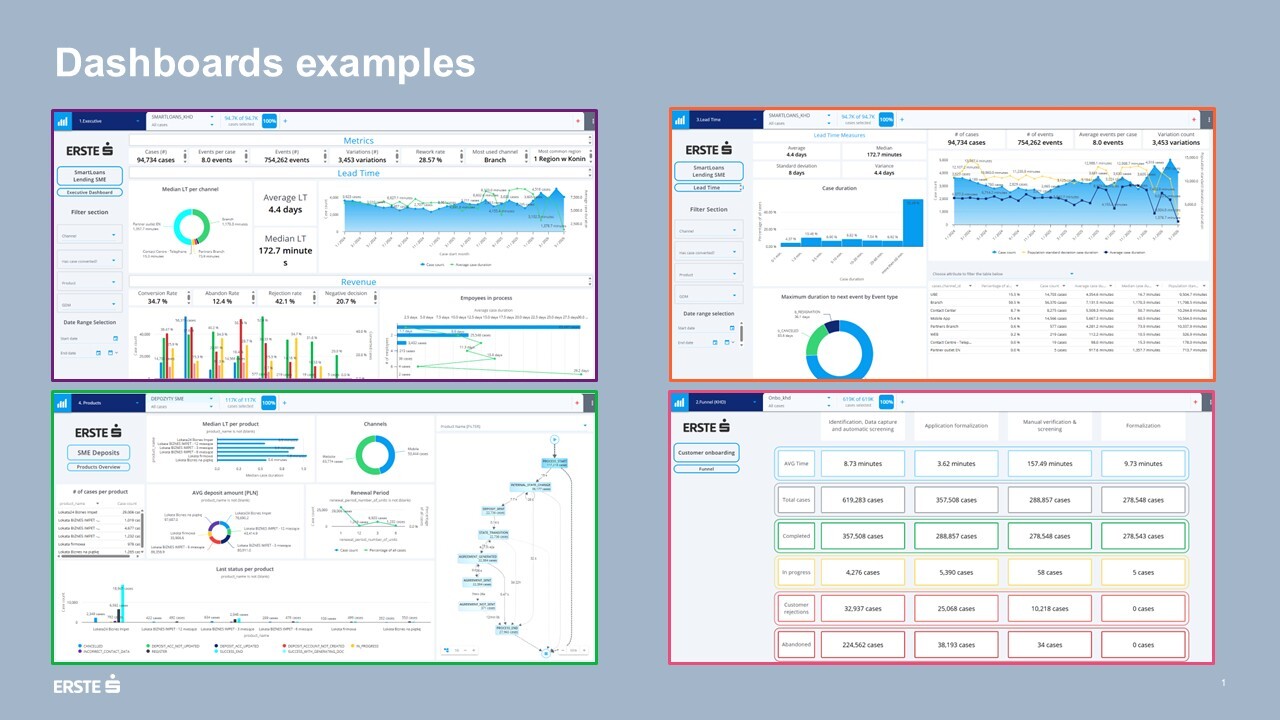
Process mining dashboards used across banking operations at Erste Bank Poland

The unlimited licensing model changed the economic calculus entirely. A lower unit cost per use case meant the bank could pursue more analyses, cover more processes, and generate more value without the previous constraint of each new initiative triggering a new line in the budget.

One of the strongest examples of business impact came from loan origination process mining. Using a custom sales funnel dashboard built in QPR ProcessAnalyzer, Erste Bank Poland analyzed its digital lending process and discovered that approximately 37% of customers abandoned their loan application before completion.

These were not applicants rejected due to credit risk. Instead, they were customers who dropped out during the digital lending journey — revealing a major hidden inefficiency in the bank’s loan origination process.

The bank did not yet know why customers were abandoning the process — but the visibility prompted the right question.

Working with business teams, Erste Bank designed an intervention: identifying abandoned applications and proactively contacting customers through its contact center to help them continue and complete the process. The result was several million PLN in additional sales — value uncovered directly through process mining visibility.
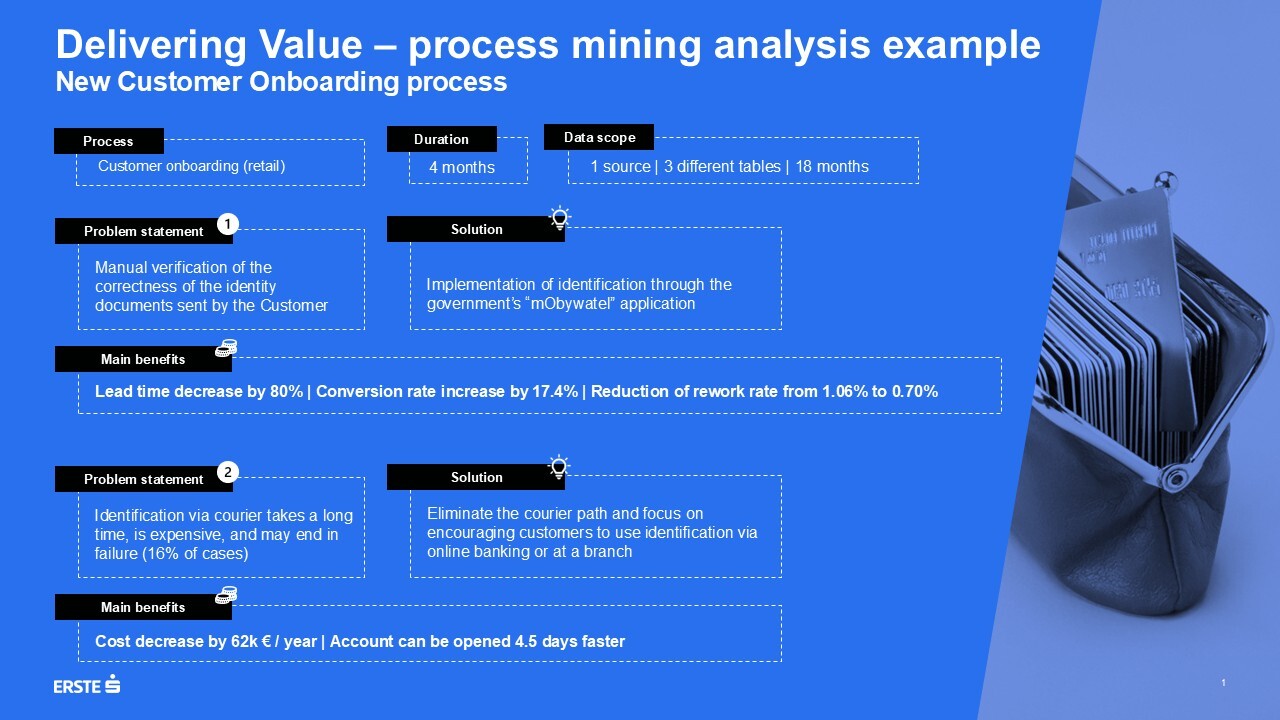
Customer onboarding process mining results at Erste Bank Poland using QPR ProcessAnalyzer

Beyond the immediate financial impact, the broader shift was cultural.

Process mining evolved from an analytical tool used by a small group of specialists into a foundation for everyday business decision-making across the organization.

With more users, broader process coverage, and faster insights, the platform became a core operational capability — not just a reporting tool.


"Real success is not the number of dashboards — but whether decisions are made based on them."
Jakub Śliwka

Manager of the Process Monitoring Team, Erste Bank Poland

Business Impact

37% customer abandonment identified in digital lending

Several million PLN in additional recovered revenue

Faster time-to-insight across business processes

Lower total cost of ownership for process mining

Expanded process coverage across banking operations

Increased business-user adoption of process intelligence

"Process mining can be a tool for niche people sitting in a corner analyzing data — or it can be the guide towards making good decisions in business. We chose the latter."
Grzegorz Zacharewicz

Head of Process Transformation Office, Erste Bank Poland

Customer Perspective

Beyond the business outcomes, Erste Bank Poland emphasized the importance of the partnership itself. Throughout the migration, QPR provided responsive support, practical expertise, and continuity that helped the bank preserve stakeholder trust and accelerate adoption. For Erste Bank Poland, the transition was not simply a platform replacement — it was a successful strategic shift that expanded the role of process mining across the organization.

Key Takeaways

Key Lessons for Financial Institutions Using Process Mining

1. Continuity is non-negotiable

If users lose access or trust — even temporarily — even the best-designed migration can fail. Protecting continuity is not a soft concern; it is the central success criterion.

2.    Economics determine scale

A pricing model that charges per use case will always cap experimentation. The ability to expand process mining coverage without triggering new costs is what makes organization-wide adoption realistic.

3.    The vendor relationship matters

Technology partnerships are tested most during difficult transitions. The QPR team’s responsiveness, expertise, and ability to support a complex migration under strict banking compliance requirements gave Erste Bank Poland the confidence to move forward — and reinforced that they had found a long-term strategic process mining partner, not just a software vendor.

Erste Bank Poland presented their migration journey at the QPR Summit 2026. The presentation was delivered by Jakub Shlivka and Grzegorz Harewic from the Process Function team.

Looking for Process Intelligence in Banking?

QPR ProcessAnalyzer helps financial institutions improve customer onboarding, loan origination, compliance, and operational efficiency with scalable on-premise and cloud deployment models.

Discover how process mining can help your bank uncover hidden inefficiencies, reduce customer drop-offs, improve conversion rates, and accelerate better business decisions.

Book a demo to see how QPR ProcessAnalyzer can support your banking operations.

FAQ: Process Mining in Banking

Why is process mining important for banks?

Process mining helps banks improve operational efficiency by analyzing how business processes actually run in real life. It enables financial institutions to identify bottlenecks, customer drop-offs, compliance risks, and inefficiencies in processes such as customer onboarding, loan origination, and internal audits.

How can process mining improve loan origination?

Process mining gives banks full visibility into the digital lending journey. By identifying where customers abandon applications or where delays occur, banks can improve conversion rates, reduce friction, and recover lost revenue.

Why did Erste Bank Poland move to an on-premise process mining platform?

Erste Bank Poland required full data ownership, regulatory compliance, and infrastructure autonomy following its transition into Erste Group. An on-premise process mining deployment allowed the bank to analyze sensitive customer data directly without cloud transfers or anonymization.

What business results did Erste Bank Poland achieve with QPR ProcessAnalyzer?

Using QPR ProcessAnalyzer, Erste Bank Poland identified a 37% customer drop-off rate in its digital lending process and recovered several million PLN in additional sales through proactive customer re-engagement.