










One governed picture of how your business works
Connect strategy, capabilities, processes, applications and data in one governed repository. Plan transformation with confidence, keep everyone working from the same picture, and give AI the rules and context it needs to act safely.
Trusted by organizations managing complex transformation
Customer rating: 9.7/10
QPR helps organizations create a shared view of how their business works — across architecture, processes, systems, and transformation.
Transformation and AI both need to know how your business works
AI without architecture guesses
An AI agent can read your data. But it doesn’t know who approves a €50,000 purchase, which systems a process depends on, or what “done right” looks like. Without that context, exceptions become guesswork.
Change crosses organizational boundaries
A change in one application, process, or capability can affect many other parts of the enterprise.
Static diagrams are not enough
Architecture needs to stay connected, governed, and usable across teams — not live in isolated files and presentations.
One connected view of your enterprise
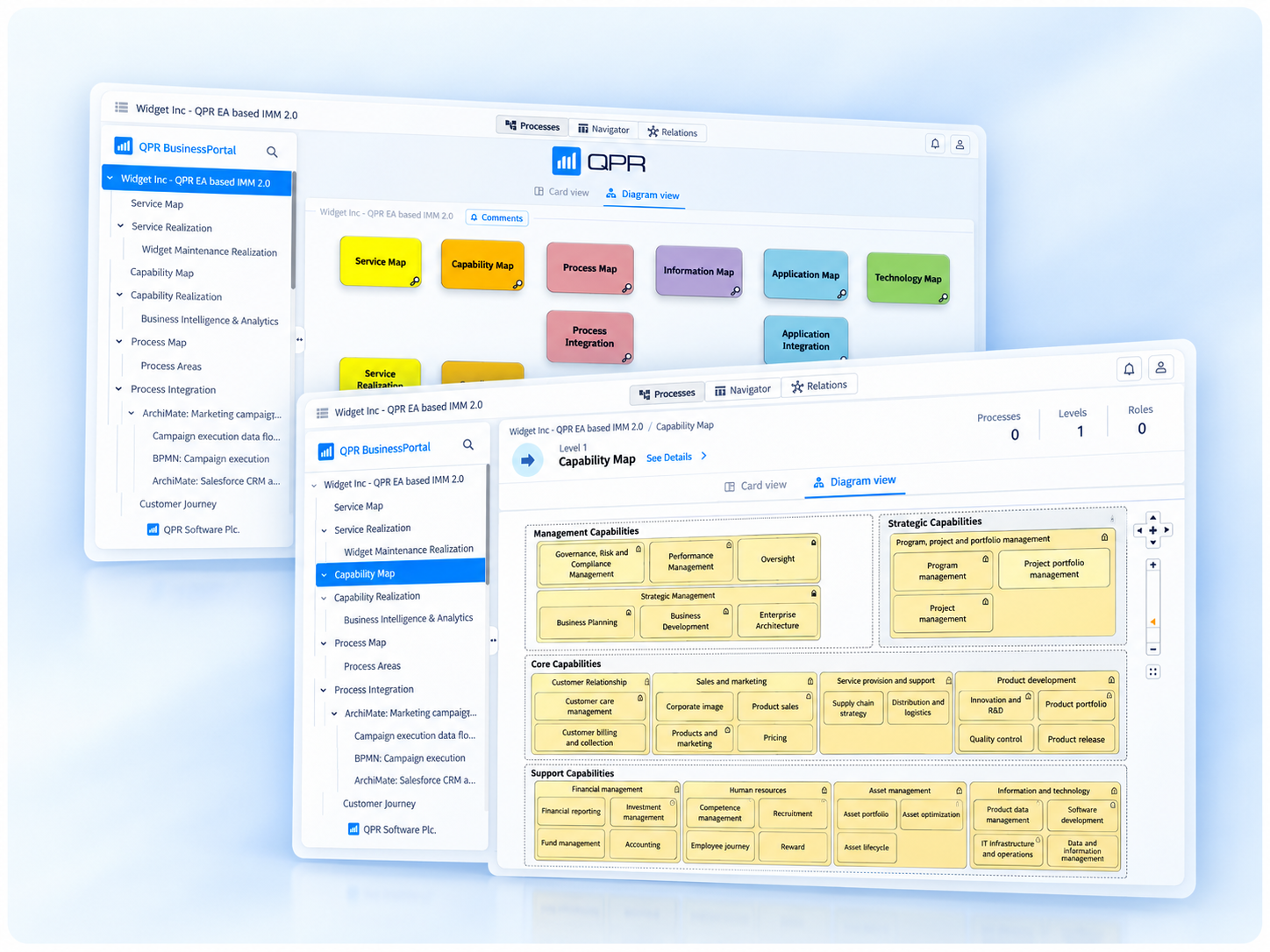
QPR EnterpriseArchitect brings your enterprise architecture into one governed repository — connecting the information you need to understand, manage, and change your organization.
Connect the whole enterprise
Strategy & capabilities
Understand what the organization needs to achieve and the capabilities required to deliver it.
Processes & customer journeys
See how work flows across teams, systems, and organizational boundaries.
Applications, data & technology
Understand dependencies and how technology supports the business.
Risks, controls & transformation
Connect change initiatives and governance directly to the parts of the enterprise they affect.
One source of truth
Model an element once and reuse it across your architecture. When information changes, the connected views stay aligned, and so does every AI assistant that relies on them.
Built on standards. Flexible for your enterprise.
ArchiMate® 3 Certified
QPR EnterpriseArchitect supports widely used enterprise architecture and process modeling standards while allowing you to adapt the underlying model to your organization's own structures and ways of working.
ArchiMate® · BPMN 2.0 · TOGAF · UML · DMN · APQC
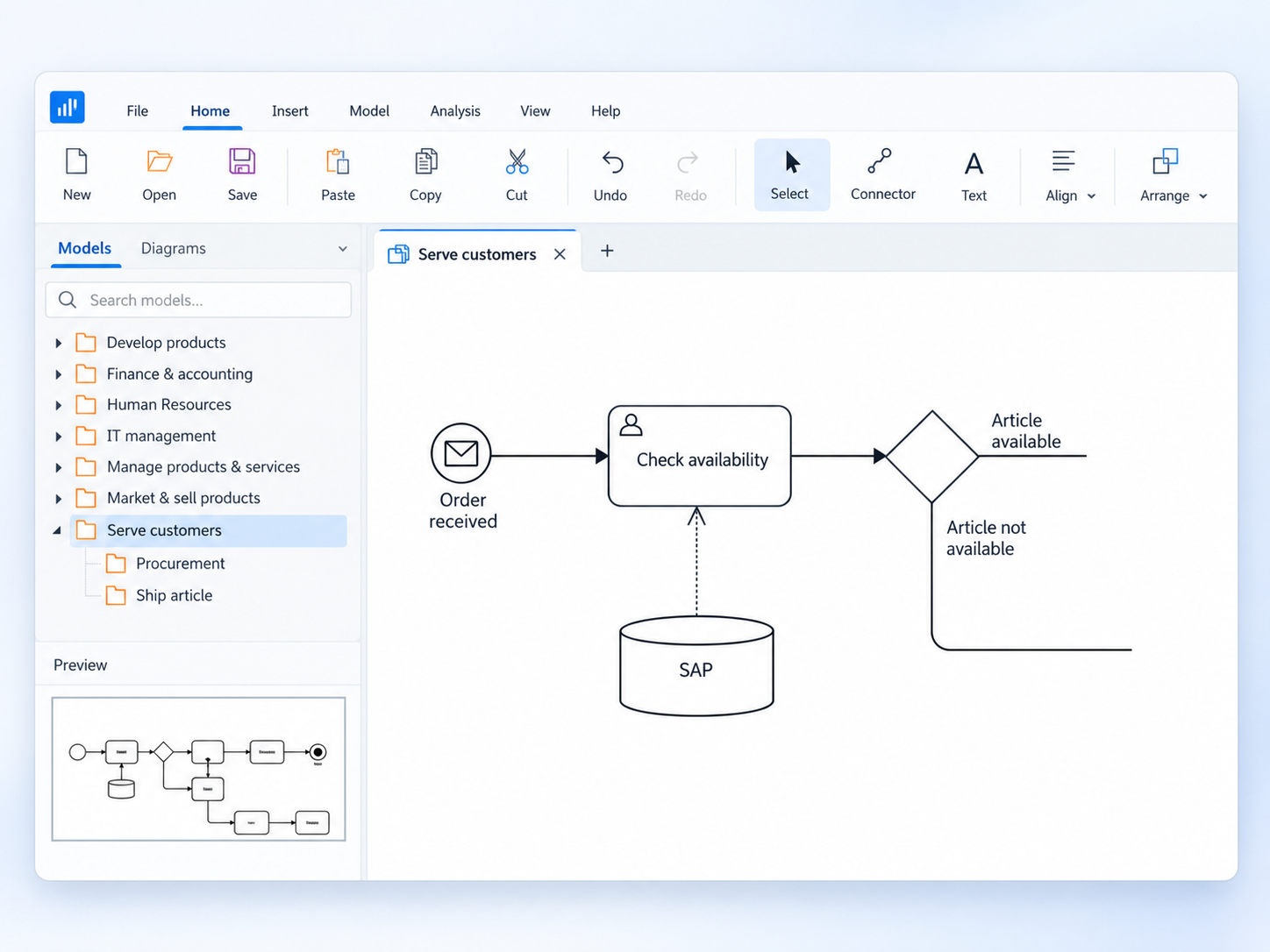
See your enterprise, and what it takes to make it AI-ready
See how QPR EnterpriseArchitect connects strategy, processes, applications and data in one governed repository, and how the same architecture can guide your AI initiatives.
Design meets reality
Your models describe how work should happen. But is that how it actually happens? Most architecture tools stop at the diagram. QPR connects your architecture to how work actually happens, so your models stay true, improvement stays grounded in facts, and AI has both the rules and the reality.
Define how work should happen
With QPR EnterpriseArchitect, you define processes, business rules, owners and dependencies — creating a trusted blueprint for how work should happen, for people and AI alike.
See how it actually happens
QPR ProcessAnalyzer shows how work really flows in your systems and where it deviates from the design.
People and AI act on both
Your teams, and increasingly AI agents, spot deviations, check the approved way of working and act within it. What you learn updates the model.
“The model you design becomes the yardstick. The reality you mine becomes the next version of the model.”
Your architecture is AI's rulebook
The architecture work you already do is exactly what AI needs. And AI built into QPR EnterpriseArchitect takes the slow, manual work out of keeping it current.
Built into QPR EnterpriseArchitect – no other product required
From text to process model
Describe a process in plain language and get a BPMN model you can refine, govern and publish.
Ask your architecture
Ask questions about your architecture in natural language and get clear explanations of processes, owners and dependencies.
Test change before you make it
Use predictions, simulation and what-if analysis to see how a change would affect the rest of the enterprise.
ARCHITECTURE + PROCESS INTELLIGENCE
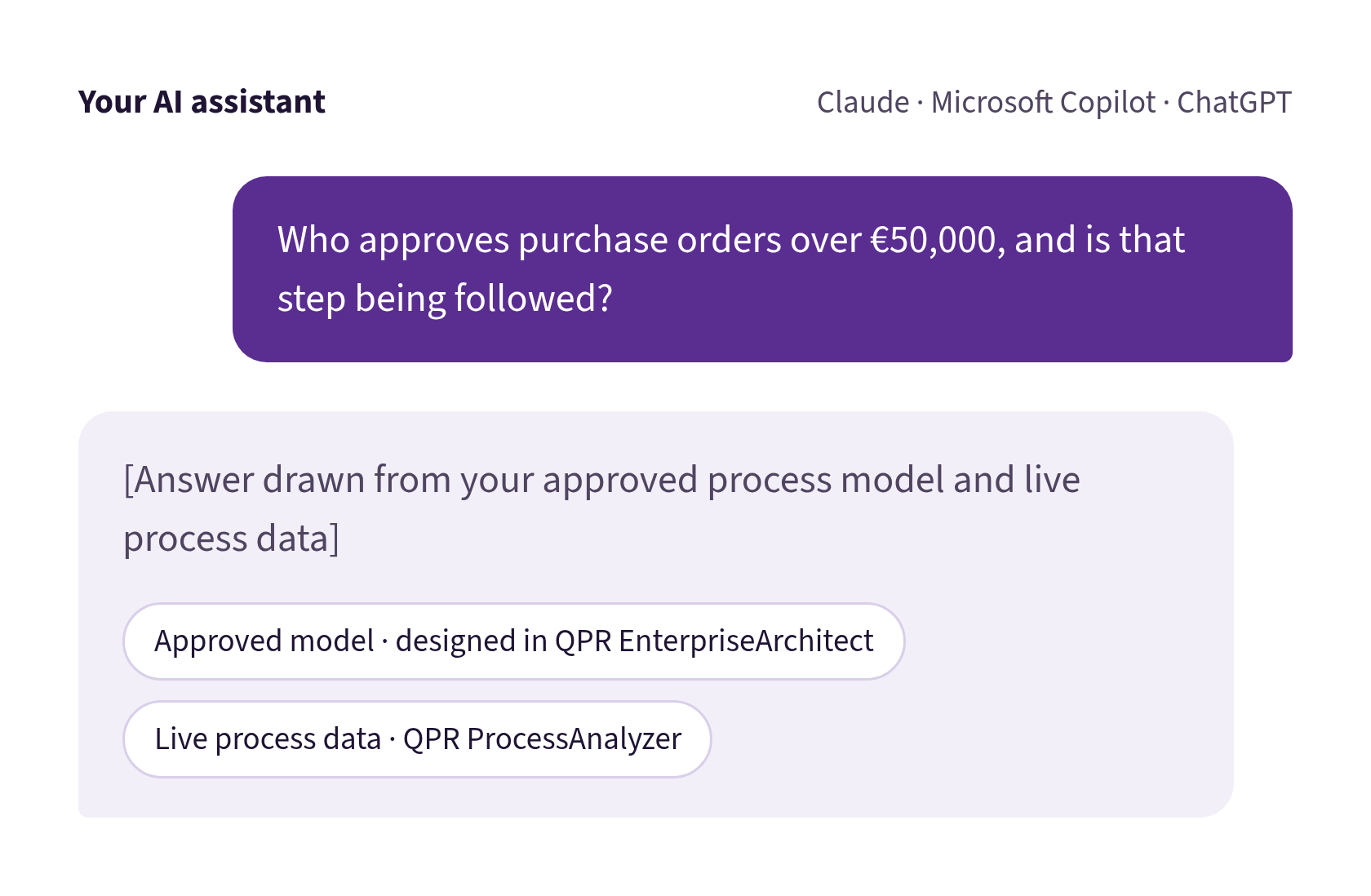
Your approved models, in the AI tools your people already use
Together, QPR EnterpriseArchitect and QPR ProcessAnalyzer connect the approved way of working with how work actually happens. Through MCP, AI assistants such as Claude, Microsoft Copilot and ChatGPT can access these insights with the same governed access rights as your users.
Governed access: AI sees only what each user is allowed to see.
No new tool to learn: Work in the AI assistant you already use.
Answers you can trace: Every answer links back to an approved model or real process data.
WHAT IS MCP?
MCP (Model Context Protocol) is an open standard that lets AI assistants connect securely to business systems. Think of it as one common plug between AI and your applications, instead of a custom integration for each.
Key capabilities of QPR EnterpriseArchitect
Model business capabilities, value streams, applications, data, technology, organizations, risks, controls, strategic goals, and their relationships in one repository.
Create and manage BPMN 2.0 process models and connect processes with the wider enterprise architecture.
Support process ownership, responsibilities, risks, controls, documentation, and related architecture information.
Turn plain-language descriptions into BPMN models, ask questions about your architecture in natural language, and use predictions, simulation and what-if analysis to test change before you make it. Through QPR's MCP interface, your approved models also give AI assistants and agents the rules and context they need.
Connect your models with QPR ProcessAnalyzer to compare designed and actual processes and see where reality deviates from the design.
Manage ownership, role-based access, model lifecycle, versions, reviews, approvals, and controlled publishing.
Governed, versioned and approved content is exactly what AI needs to trust a source.
Make architecture available in the browser for business users, decision-makers, and other stakeholders.
Publish approved views, collect feedback, and extend architecture beyond specialist teams
Work with widely used architecture and process standards, including:
ArchiMate® · BPMN 2.0 · TOGAF · UML · DMN · APQC
Exchange architecture information using formats including BPMN 2.0 XML, ArchiMate Model Exchange, XML, and CSV.
One version-managed repository and one configurable, open metamodel — a single source of truth for your architecture, with governance built in
Start with architecture. Grow into process intelligence.
Use QPR EnterpriseArchitect on its own, or together with QPR ProcessAnalyzer as one process intelligence platform built on one repository and one metamodel. Start with what you need today and add the rest when you're ready.
YOU ARE HERE
QPR EnterpriseArchitect
Define how work should happen.
PROCESS MINING
QPR ProcessAnalyzer
See how work actually happens →
See how organizations use QPR EnterpriseArchitect
Customer story: St1 Nordic
Building a shared operating model for a changing business
See how St1 uses QPR EnterpriseArchitect to support acquisitions, business models, and continuous transformation.
READ CUSTOMER STORY →
Customer story: YIT
Creating a common architecture across a merged organization
See how YIT harmonized operations and created a unified management system with QPR EnterpriseArchitect.
READ CUSTOMER STORY →
Your architecture already holds the rules. Put them to work.
See how QPR EnterpriseArchitect fits your transformation and AI plans, and bring your toughest architecture questions.
Frequently asked questions
QPR EnterpriseArchitect is enterprise architecture software that connects strategy, capabilities, processes, applications, data and technology in one governed repository. It helps organizations plan transformation, manage change across organizational boundaries, and give people and AI a shared picture of how the business works.
Yes. QPR EnterpriseArchitect is an ArchiMate® 3 certified tool and supports the TOGAF® framework with ready-made templates.
ArchiMate, BPMN 2.0, TOGAF, UML, DMN and the APQC process classification framework.
It connects architecture to how work actually happens. Together with QPR ProcessAnalyzer, your process models become the yardstick for real process data, so you can see where reality deviates from the design. Architecture and process modeling share one repository and one metamodel.
AI can only automate what is clearly defined. QPR EnterpriseArchitect is where processes, business rules, owners and dependencies are defined and governed, giving AI the rules and operational context it needs. Its current built-in capabilities include scenario modelling and simulation, what-if analysis, change impact analysis, and AI/ML-based predictions. AI-assisted process modelling and natural-language queries about your architecture content are on the roadmap. Generative AI use cases such as generating BPMN models from text and natural-language process insights are delivered through QPR ProcessAnalyzer.
Yes, through QPR ProcessAnalyzer. Process models designed in QPR EnterpriseArchitect can be used in QPR ProcessAnalyzer, whose MCP server gives AI assistants governed access to process insights with the same access rights as your users.
No. QPR EnterpriseArchitect and its built-in AI features work on their own. QPR ProcessAnalyzer adds process mining and AI assistant access through MCP.
Insights from QPR
Explore expert perspectives, customer stories and practical ideas on process intelligence, enterprise architecture and AI-driven transformation.

Where Process Intelligence Is Heading: 5 Questions with Gary Chitan of TOCH Consulting