Order-to-Cash decides how quickly a company turns customer orders into cash. Every order change, late delivery, invoice correction and overdue payment can increase costs, delay cash collection and tie up working capital.
In large organizations, Order-to-Cash involves thousands or even millions of transactions across multiple systems and business units. This complexity creates opportunities for errors, delays and inefficiencies that are difficult to detect without a complete view of the process. A high volume of transactions makes the process prone to errors and inefficiencies – and most of them stay hidden between ERP, CRM, logistics and finance systems.
This also makes Order-to-Cash an ideal target for process mining (what is process mining). Process mining shows how orders actually move through your organization, helps you find the root causes of problems such as order changes, and points to where automation pays off.
In this article, I explain what process mining reveals in Order-to-Cash and share three practical ways to use QPR ProcessAnalyzer to improve it. Since this article was first published in 2020, process mining has moved from one-off analysis to continuous process intelligence – I have updated the text to reflect how it is done today.
What is the Order-to-Cash process?
The Order-to-Cash process, also known as OtC or O2C, is the end-to-end business process that covers all activities between a customer order and the payment for that order. It connects sales, order management, logistics, customer service and finance, and it turns orders into cash. This makes Order-to-Cash one of the most vital core processes in any organization.
What are the steps in the Order-to-Cash process?
The Order-to-Cash process generally includes the following steps:
-
Order creation – a customer places an order with one or multiple items, and it is recorded as a sales order.
-
Order fulfillment – the sales order is prepared for shipment, or a service appointment is scheduled.
-
Shipment or service delivery – the order is shipped to the customer, or the service is completed.
-
Invoice creation – an invoice is created and sent to the customer (if not already paid during order creation).
-
Payment and invoice clearing – the customer pays, the payment is matched to the invoice and registered to the General Ledger.
These steps vary with the business model. Organizations typically run their business as Make-to-Stock, Make-to-Order or service business.
Make-to-Stock is the most straightforward: goods are produced and restocked in the warehouse, ready for picking and shipping according to sales orders. In Make-to-Order, goods are produced or purchased specifically for each order. In service business, a project is kicked off after the order is received, and invoicing may depend on milestones or approvals.
In reality, the Order-to-Cash flow is never this simple. Orders are changed, deliveries split and rescheduled, invoices corrected and payments delayed. Each deviation adds manual work, prolongs lead times and delays the moment the cash arrives.

How does process mining work for Order-to-Cash?
When the Order-to-Cash process is executed, events such as "Sales Order Created", "Delivery Posted" and "Invoice Created" are recorded in your information systems – ERP, CRM, warehouse and invoicing systems. Each record includes a timestamp that shows when the event took place. In other words, every executed step of your Order-to-Cash process already exists as data.
Process mining combines these events into a process flow that shows how the process is actually executed, instead of how it is assumed to work in workshops and process descriptions. With it, you can see:
-
Bottlenecks – where orders, deliveries, invoices or payments wait.
-
Rework and order changes – how often orders are modified or steps repeated.
-
Process variants – which paths differ from the intended process, and what they cost.
-
Rule violations – where required steps, approvals or credit checks are skipped.
-
Automation opportunities – which manual steps are frequent and repetitive enough to automate.
Getting the data. QPR ProcessAnalyzer reads event data with pre-built connectors for the systems where Order-to-Cash work happens – SAP (R/3, S/4HANA and HANA), Oracle NetSuite, Salesforce, ServiceNow, Microsoft Dynamics, IFS, Epicor and others – and from custom sources through APIs and database connections. For organizations running on Snowflake, QPR ProcessAnalyzer runs natively in the Snowflake AI Data Cloud, and is also available as a Snowflake Native App. The analysis happens where the data already lives, without copying it to a separate platform. Cloud, hybrid and on-premises deployments are supported as well. (Explore Snowflake-native process intelligence)
Why Order-to-Cash needs object-centric process mining. Traditional process mining forces all data into one case ID, typically the sales order. But Order-to-Cash is not one object: one order has several order items, an item can be split into several deliveries, and one invoice can cover several deliveries. Flattening this into a single case either duplicates events or hides them, which distorts lead times and frequencies.
Object-centric process mining (OCPM) analyzes orders, order items, deliveries and invoices as interacting objects in one model. QPR ProcessAnalyzer supports object-centric process mining and the OCEL 2.0 standard, so you can answer questions such as which partial deliveries delay invoicing without losing the connection between objects.
Three practical ways to improve your Order-to-Cash process with QPR ProcessAnalyzer
Improving Order-to-Cash does not have to start with a large transformation program. In my experience, the projects that deliver results follow three steps:
-
Discover how your Order-to-Cash process actually works.
-
Find the root causes of delays and rework.
-
Monitor performance continuously and measure the effect of changes.
1. Discover and benchmark your as-is Order-to-Cash process
Process mining automatically creates process flowcharts from the events recorded in your systems. From them, you see how your Order-to-Cash process performs, based on data. Undesired behavior is easy to spot: steps that are skipped, steps that happen more than once, and steps that take most of the time.
Duration analysis and variation analysis show where the main issues, such as late deliveries or late payments, occur and how many variations the process has. You can compare business units, regions, customer segments and order types against each other, which gives you an internal benchmark.
A typical finding: some orders move back and forth between sales and logistics several times before delivery is approved, while comparable orders go through without extra handling. That difference is where the investigation starts.
The goal is not a nicer process picture. It is a measurable baseline that later improvements are compared against.

2. Understanding the root causes of the issues in your Order-to-Cash process
Knowing that invoices are often late is useful. Knowing why they are late is what lets you fix it.
After discovery, QPR ProcessAnalyzer's AI-powered Root Cause Analysis helps identify the attributes, process steps and event patterns associated with the issue you are investigating. It highlights the most significant contributing factors, helping you prioritize improvements based on their potential business impact.
For example, late invoicing may turn out to be concentrated in orders that had several delivery date changes – and those changes, in turn, trace back to incomplete order data at entry. Instead of chasing individual late invoices, you fix the order entry.
Root cause analysis also finds role models to learn from: teams, sites or customer segments that consistently outperform others. Studying how they work shows improvement opportunities that can be copied elsewhere.

3. Continuously monitor and improve with a ready-made Order-to-Cash application
Every improvement initiative needs follow-up: did the change work, and are new problems emerging? QPR ProcessAnalyzer includes a pre-built Order-to-Cash application with dashboards for the KPIs that matter most:
These KPIs connect operations to finance. Fewer order changes shorten delivery lead times; faster and correct invoicing shortens the time to cash.
You can also set up automated alerts by email, Slack or webhooks whenever a business rule or KPI threshold is broken – for example a late delivery, a compliance deviation or a missed SLA. QPR ProcessAnalyzer also uses machine learning to predict on-time delivery, so you can act on delivery risks before they materialize.
Order-to-Cash overview. The Operations Overview dashboard gives a quick view of volumes by location and over time, together with SLA compliance, lead times and automation rates.
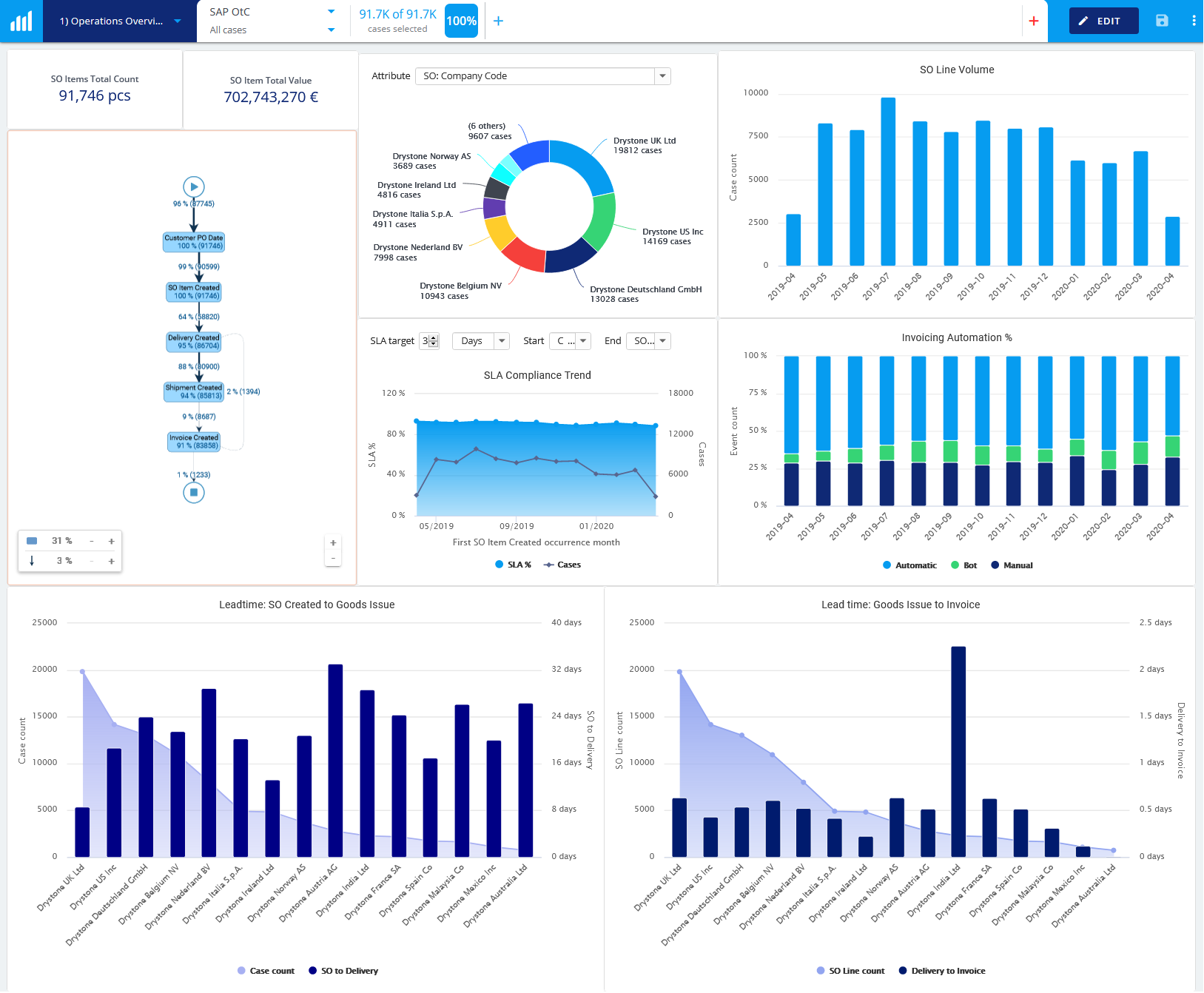
Delivery on-time performance. Shows where recurring delays occur and compares performance across business units, customers and product groups.

Lead time analysis. Shows where time is spent between process steps and which steps contribute most to long cycle times.

From every dashboard you can drill down to individual orders, so a KPI never stays an abstract number.
Customer spotlight: OTE Group
In telecoms, the order-to-cash logic appears as order-to-activation: the customer pays from the moment the service is active, so every day between order and activation is lost revenue.
OTE Group, the Greek telecommunications group and member of Deutsche Telekom Group, used QPR ProcessAnalyzer to analyze two order-to-activation processes: B2C fiber-to-the-home (FTTH) and B2B digital office. In the FTTH process, the analysis identified a potential 3-day reduction in end-to-end cycle time through an improvement in the appointment stage. It also showed that external partners did not always follow the intended process, with regional differences. In the B2B process, delays were linked to system fallouts – a root cause that had not been connected to them before.
From process mining to process intelligence for AI
The biggest change since 2020 is who uses the analysis. Process mining used to be a tool for analysts working in dashboards. Today, the same process intelligence can be used through the AI tools people already work with.
Through the QPR MCP Server (Model Context Protocol), AI assistants and agents such as ChatGPT, Claude, Microsoft Copilot and Snowflake Cortex Agents can query process flows, bottlenecks, KPIs and root causes from QPR ProcessAnalyzer. An Order-to-Cash manager can ask:
-
"Where are our biggest order fulfillment delays this quarter?"
-
"Which factors are linked to late invoicing?"
-
"Which process variants create the most rework?"
The division of work matters: QPR ProcessAnalyzer does the process analysis on real event data, and the AI tool makes the answer easy to reach. The answer is grounded in how your orders actually flowed, not in the AI model's general assumptions about Order-to-Cash. On Snowflake, this happens without moving the data out of your Snowflake account.
Learn how QPR brings process intelligence into enterprise AI tools
What are the benefits of process mining in Order-to-Cash?
With process mining, you can see exactly:
-
How long it takes for an order to turn into cash – and where the time goes.
-
How many orders are changed during the process, and what those changes cost.
-
Where invoicing and payment delays tie up working capital.
-
How well your organization uses automation.
-
Where the process deviates from rules and internal controls.
The most valuable insight is rarely the longest step in the process. It is the inefficiency with the biggest effect on cost, cash flow and customer experience.
To round it up
Your ERP and other business systems already contain a complete record of how orders move through your organization. With QPR ProcessAnalyzer, you can rely on that real data when analyzing your Order-to-Cash process – from discovery to root causes to continuous monitoring. When you understand the strengths and weaknesses of your process, you can focus improvement initiatives on the areas that produce the most value.
Related reading

Object-Centric Process Mining: When One Process View No Longer Tells the Whole Story
The most commonly asked questions about process mining software