Many process mining platforms were purchased years ago, before enterprises moved their data into cloud data platforms and started building AI capabilities around them. Yet at renewal time, they are often still evaluated against the same criteria: features, dashboards and license price.
In a new expert article, 7 Questions to Ask Before You Renew Your Process Mining Contract, QPR’s Senior Process Intelligence Consultant Jaakko Niemi explains why these criteria no longer tell the whole story.
“Many renewals still come down to features and license prices. But the bigger question today is whether the platform fits the company’s data architecture and AI plans. Getting that wrong can be far more costly than a missing feature.”
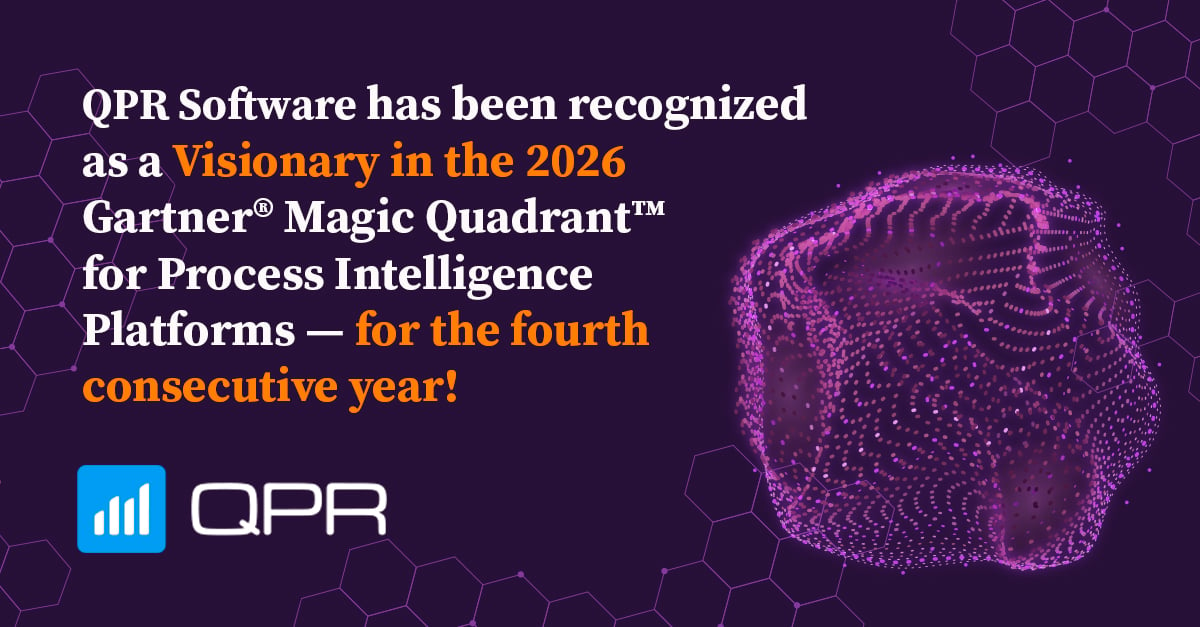
Independent research points in the same direction. In its 2026 Magic Quadrant for Process Intelligence Platforms, Gartner notes that process intelligence platforms provide the context organizations need to plan and prioritize where to deploy AI agents. That gives buyers good reason to ask how a platform supports their wider AI plans, not only what it analyzes today.
Three changes reshaping process mining evaluations
The article highlights three considerations that deserve greater attention as enterprises adopt AI.
Where the data lives. A process mining platform that requires a separate copy of enterprise data can add storage costs, data pipelines and security requirements on top of existing cloud data infrastructure.
Who can access process insights. AI assistants can make process intelligence available to business users without requiring them to learn a specialist analytics tool. But the platform must be able to provide those insights to AI applications.
How AI agents are monitored. As enterprises deploy AI agents, they also need visibility into how those agents run: where they get stuck, which steps they repeat and what drives their cost.
Niemi’s article outlines seven questions covering data architecture, total cost of ownership, scalability, access to insights, vendor lock-in, governance and AI readiness. It also identifies the stakeholders who should take part in the evaluation.
How QPR answers these questions
QPR has developed its process intelligence technology around these requirements.
QPR’s process mining and process intelligence platform, QPR ProcessAnalyzer runs as a Snowflake Native App directly inside the customer’s Snowflake account, without requiring a separate copy of process data. Organizations whose data is not in Snowflake get the same architecture through a QPR-managed environment, without needing their own Snowflake subscription. QPR’s CEO Matti Erkheikki explains the thinking behind this architecture in Move the Intelligence, Not the Data.
Through the QPR MCP Server, which uses the open Model Context Protocol standard, people can ask process questions in familiar AI assistants and receive answers based on actual process data.
QPR AI Agent Mining for Snowflake extends process intelligence to analyzing AI agents’ execution traces within Snowflake.
For organizations approaching a contract renewal, the article offers a timely question: would you choose the same process mining platform today, knowing what your data and AI strategy now requires?
Read the expert article: 7 Questions to Ask Before You Renew Your Process Mining Contract
For further information:
QPR Software Plc
Matti Erkheikki
Chief Executive Officer
Puh. +358 40 717 2570
Gartner, Magic Quadrant for Process Intelligence, Tushar Srivastava, Marc Kerremans, David Sugden, 5 May, 2026.
Gartner and Magic Quadrant are trademarks of Gartner, Inc., and/or its affiliates.
Gartner does not endorse any company, vendor, product or service depicted in its publications, and does not advise technology users to select only those vendors with the highest ratings or other designation. Gartner publications consist of the opinions of Gartner’s business and technology insights organization and should not be construed as statements of fact. Gartner disclaims all warranties, expressed or implied, with respect to this publication, including any warranties of merchantability or fitness for a particular purpose.
onment to secure, a first analysis can be delivered in hours and real value within days.”
The approach also works at enterprise scale. Ericsson uses QPR ProcessAnalyzer for global trade compliance analytics in a Snowflake environment, with more than 1.2 TB of data and 10–20 million new transactions every month.
Organizations that don’t use Snowflake can still benefit. QPR ProcessAnalyzer is available as a managed solution that runs on a Snowflake environment operated by QPR, so the customer doesn’t need its own Snowflake subscription.